The Right to Change Your Mind
The only certainty about the future is that it will change. Which makes the right to change your mind perhaps the most expensive privilege in any negotiation.

Read the Chinese version here.
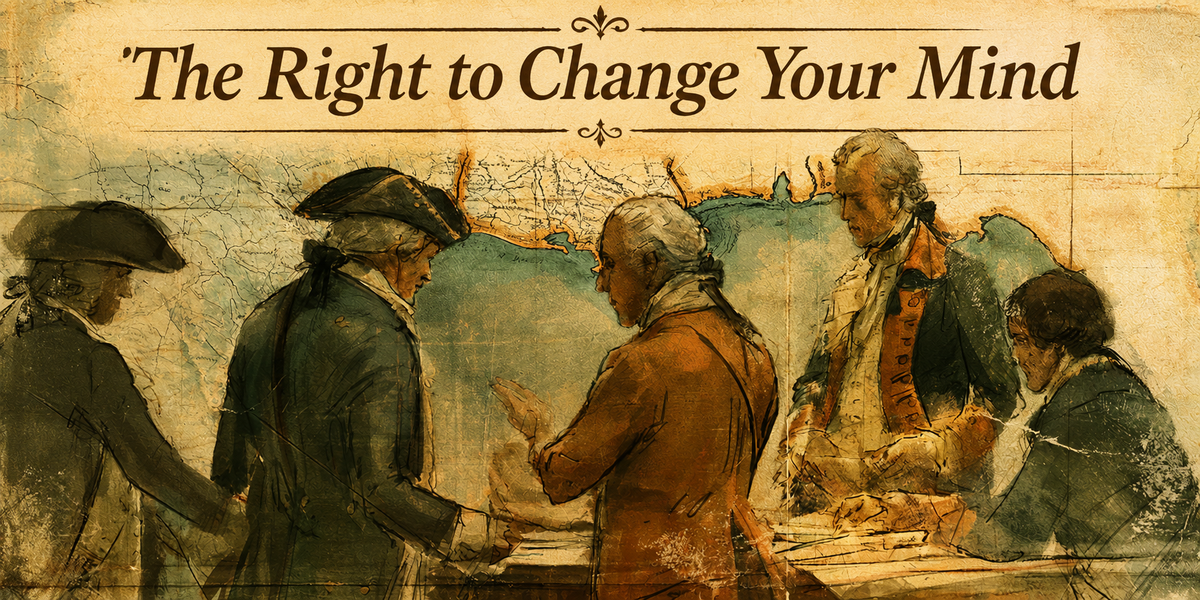
In January 2023, I wrote a short analysis of the Microsoft/OpenAI deal, using the Louisiana Purchase as an analogy.

The story begins in 1803. The Americans went to France hoping to buy the port of New Orleans. They had a limited budget, a specific mandate, and presumably some idea of what a successful negotiation might look like.
Napoleon offered to sell them the whole of Louisiana.
This was rather more than they had come for. It was also considerably more than President Jefferson had authorized them to buy. But opportunities of that magnitude do not tend to invite lengthy discussions about administrative procedure. The American negotiators were delighted, and the deal was done.
What interested me was the other side of the table.
Why did Napoleon sell?
In that tweet, I said this could be a full-blown article. Then I got lazy. Three years and ten months later, I have finally decided to explain what I was getting at.
Napoleon had little use for an enormous territory across the Atlantic. It was difficult to defend, expensive to maintain, and a distraction from his real concerns, which were France and Europe. Holding on to Louisiana would have meant spending troops, money, and attention on something whose strategic value lay in a distant and increasingly uncertain future.
And the future Emperor was short of cash. Rather badly, as it happened.
So he sold. The Americans had set out to acquire a port and returned with territory that would eventually account for roughly a quarter of the United States.
Now consider OpenAI in January 2023.
If AGI was genuinely within reach, OpenAI's reported valuation of $29 billion looked rather ridiculous. Granted, $29 billion contains an impressive number of zeros. It is still a modest price for a substantial claim on the economic future of artificial intelligence, assuming that future was about to arrive.
Napoleon had sold a vast territory and its future potential for the price of something much smaller. Was Sam Altman doing roughly the same thing?
Sam needed money. That much was obvious. Training frontier models was expensive, and the computing requirements were becoming astronomical. He was also an unusually capable dealmaker. Nobody had suggested that he lacked commercial imagination.
Why, then, was he willing to give away so much of the future?
The other question bothered me even more: why was Microsoft willing to accept the AGI clauses?
That was when I began to suspect AGI was still a very long way off.
I still consider the reasoning sound. When someone tells you what they expect from the future, you can listen politely. When they sign a contract involving billions of dollars, you should probably pay rather closer attention.
The latter tends to be a more expensive form of honesty.
I have considerable respect for Microsoft's negotiating abilities. The company has spent decades making some of the most sophisticated commercial and intellectual property agreements in the technology industry. Google may operate in the same league. There aren't many others.
And Microsoft is particularly good at one thing that doesn't attract much admiration: defining rights, obligations, and risks with almost pedantic precision.
I have read enough of its contracts to appreciate the art.
Which makes the original AGI arrangement such an interesting document.
The 2023 deal contained an extraordinary provision. Upon a contractual determination of what was called Sufficient AGI, Microsoft's exclusive rights could become nonexclusive, and OpenAI would gain greater freedom from the commercial restrictions governing their partnership. AGI technology itself was outside Microsoft's original license.
OpenAI's board also had a decisive role in determining whether AGI had been achieved. There were agreed definitions and contractual conditions, naturally, but the essential point remained: Microsoft had accepted an arrangement in which a judgment made within OpenAI could materially alter the privileges Microsoft had paid to secure.
Think about that for a moment.
Microsoft was investing billions in a company whose ultimate technological achievement could leave Microsoft without the exclusive advantages it had purchased. It would retain important existing rights and an equity interest, but the prize everyone was supposedly racing toward was not automatically included.
A very wealthy angel investor, perhaps. One with excellent taste.
Personally, if I knew that OpenAI was about to achieve AGI and nevertheless approved such a contract, I would have some difficulty facing myself afterward. The appropriate professional response would lie somewhere between resignation in disgrace and seppuku.
This is the sort of thing that makes me admire Microsoft even more, because there is simply no chance that its people failed to notice the problem.
We are talking about Microsoft. Lawyers, commercial negotiators, engineers, risk managers, and people who have spent most of their professional lives considering how an apparently harmless sentence might become ruinously expensive ten years later.
Nor was Microsoft dealing with a technology it had encountered for the first time over lunch. Its relationship with OpenAI began in 2019. By 2023, it had spent years working closely with the company. Whatever Microsoft's internal assessment was, it had people capable of making one.
Yet it signed.
That was the part I found revealing. Sam Altman had accepted the price of the money he needed. Microsoft had accepted the risk of losing important rights if AGI arrived. Both sides were sophisticated enough to understand what they were doing.
My conclusion in January 2023 was that AGI must be rather farther away than the public rhetoric suggested.
The years since have not done much to shake that conviction.
In January 2025, Sam announced that OpenAI was confident it knew how to build AGI. GPT-5 arrived on August 7 that year. There was, predictably, a certain amount of anticipation.
It is now late 2026, and apparently we still know how to build AGI. Perhaps the next version will finally drive itself. Sorry, achieve AGI. I seem to have strayed into Elon Musk's garage.
Microsoft, meanwhile, continued its close collaboration with OpenAI after the agreement. And for quite some time, there was no publicly announced overhaul of the AGI provisions.
Then came October 2025.
The two companies announced a substantially revised agreement. OpenAI's declaration of AGI would now require verification by an independent expert panel. Microsoft's intellectual property rights to OpenAI's models and products would continue through 2032, including models developed after AGI, subject to the agreed safeguards. Microsoft could also pursue AGI on its own or with other partners.
The concessions that had looked so precarious in 2023 were now risks Microsoft could manage.
All very sensible.
But that wasn't the most entertaining part of the deal.
OpenAI also committed to purchasing an additional $250 billion in Azure services.
I do enjoy a large number, especially when it has been negotiated into a contract.
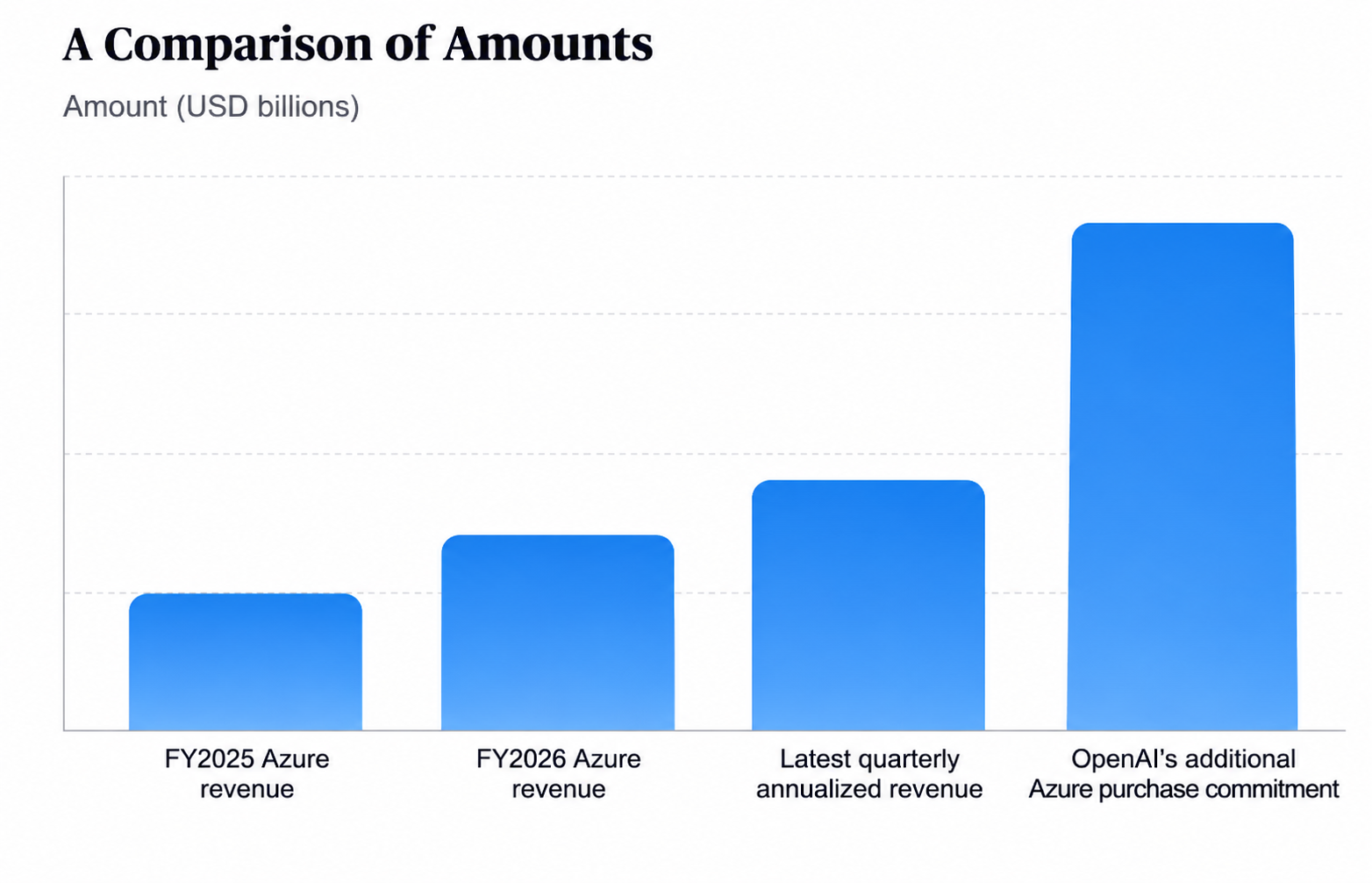
Azure generated more than $75 billion in revenue during Microsoft's 2025 fiscal year. That means the additional purchasing commitment from OpenAI was equivalent to more than three years of Azure's revenue at the time.
Three years of revenue, from one customer, negotiated as part of one arrangement.
These are future purchases, of course, rather than cash already sitting in Microsoft's bank account. I would still be reasonably pleased to have them in writing.
And the $250 billion is only one part of the arithmetic.
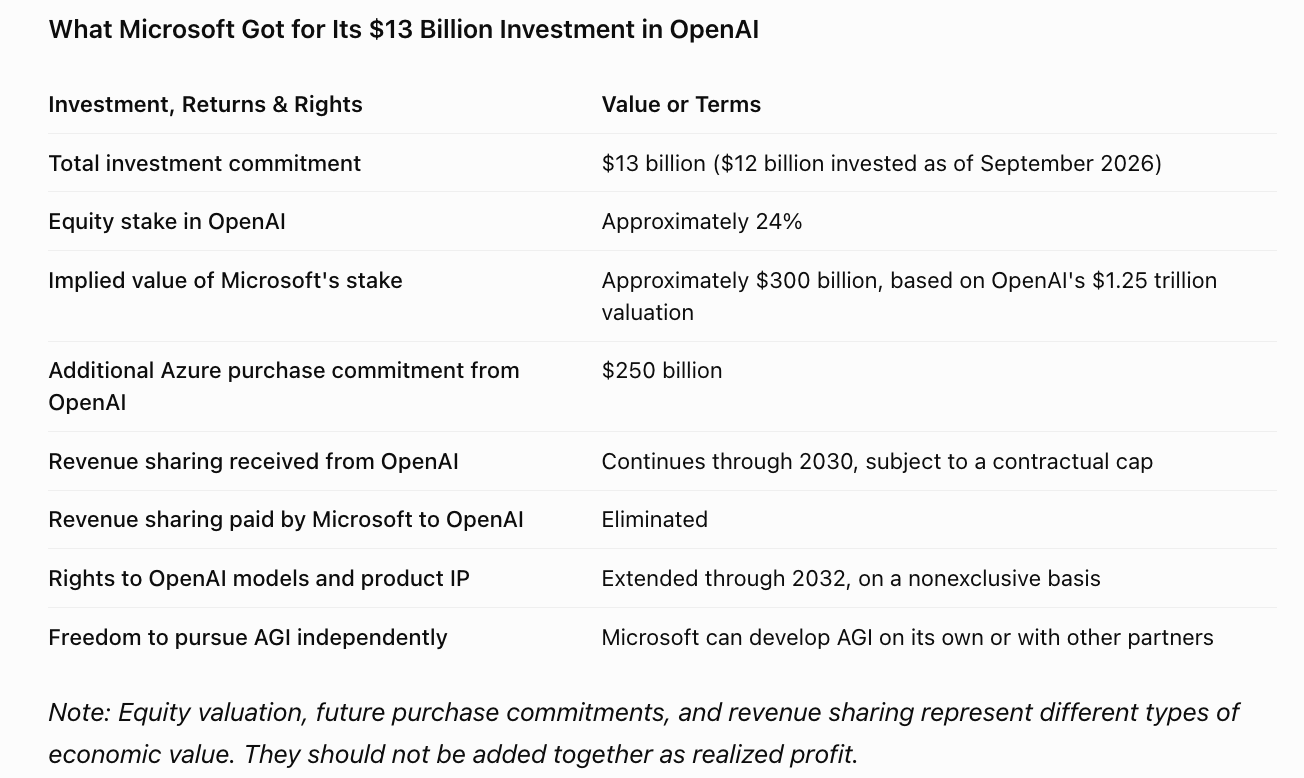
Microsoft had made approximately $13 billion in funding commitments to OpenAI. Following the restructuring in October 2025, its roughly 27% stake was valued at about $135 billion. By September 2026, Microsoft's ownership had been diluted to approximately 24%. OpenAI's latest funding round, according to reports in November 2026, valued the company at $1.25 trillion. Apply that valuation to Microsoft's stake and you get approximately $300 billion.
On paper, admittedly. A private-company valuation is not a bank balance. But there are worse things to have on paper, and $300 billion is a particularly agreeable collection of zeros.
So Microsoft kept its equity, obtained an enormous commitment to buy Azure services, secured access to future models, and made the AGI provisions considerably less dangerous.
I really must take my hat off to the people who negotiated this.
Of course, OpenAI got something important too. It wanted greater freedom to work with other cloud providers, develop its commercial relationships, and pursue its own future without Microsoft having a privileged position in every decision.
By April 2026, the two companies had revised their agreement again. Microsoft would no longer pay revenue sharing to OpenAI. OpenAI would continue sharing revenue with Microsoft through 2030, at the existing percentage but subject to an overall cap, and the payments would no longer depend on technological progress.
Microsoft's model and product license became nonexclusive, while continuing through 2032. The AGI provisions had gradually ceased to be a sword hanging over Microsoft's head.
And here is the part I find most impressive: under the new arrangement, Microsoft doesn't particularly need to win the argument about AGI. It can leave that to the researchers, philosophers, executives, and assorted prophets who seem to enjoy it so much.
Microsoft has Azure. It has Office, enterprise customers, distribution, and its own research capabilities. It can continue working with OpenAI and develop alternatives at the same time. If OpenAI produces something extraordinary, Microsoft has considerable economic exposure to that success. If another company produces a better model, Microsoft has room to adapt.
It has made itself less dependent on a single outcome.
Some businesses spend a fortune trying to buy freedom. Microsoft seems to have negotiated for freedom and emerged with money, equity, licensing rights, and a quarter of a trillion dollars in future cloud purchases.
An unusually successful shopping expedition.
There was another small episode that caught my attention. On July 9, 2024, Microsoft voluntarily surrendered its nonvoting observer seat on OpenAI's board.
I rather liked that move.
A board observer seat sounds useful. You get information, proximity, and a view of what's happening inside a company in which you have invested a considerable amount of money. What you don't get is a vote.
There is an awkwardness in that arrangement that becomes more pronounced as the relationship grows complicated. You may know enough to be asked difficult questions about what you knew, while possessing remarkably little formal authority to do anything about it. Add regulatory scrutiny to the equation and the advantages of being an informed observer begin to look less straightforward.
Information is an asset until it becomes a burden. Giving up a seat can be every bit as deliberate a commercial decision as obtaining one. This is what I think of when companies talk about agility.
The word has acquired some unfortunate associations. In certain organizations, agility seems to mean skipping approvals, leaving contractual obligations conveniently ambiguous, and treating legal compliance as an obstacle invented by people who don't understand innovation.
A review is postponed. Due diligence is abbreviated. Someone arranges dinner with the right people. Everybody shakes hands, and a complicated problem is declared solved.
Efficient, certainly.
The difficulty is that boundaries move. A shortcut that appears harmless today may become an expensive problem tomorrow, particularly once regulators, investors, competitors, and lawyers develop an interest in what was actually agreed.
Technical debt can sometimes be paid down by refactoring code. Compliance debt may require refactoring the entire business model.
I have seen enough organizations confuse speed with the absence of immediate consequences. The distinction usually becomes clearer with time, although time is not always kind enough to provide a gentle explanation.
A company with mature risk management retains room to maneuver after the world has changed. It knows which rights to protect, which obligations to limit, and occasionally which privileges to surrender.
Microsoft understands this extremely well.
In my previous essay, Everyone Is Someone Else's Customer, I looked at the increasingly circular financing arrangements in the AI industry. Companies invest in one another, supply one another, and purchase enormous quantities of computing capacity from one another. The figures are impressive. I remain interested in how much independent end-user demand will eventually support all of it.
There is a related question that has been bothering me.
What happens if the forecasts are wrong?
Some companies can renegotiate contracts, change technology providers, or shift their business models. Others have committed to long-term debt, fixed purchasing obligations, and equipment that begins depreciating the moment it is installed.
Even if AI ultimately delivers everything its enthusiasts promise, there is no guarantee that every participant in the current investment frenzy will survive to enjoy the returns.
Being right about the future is useful. Being able to survive an incorrect prediction is probably more useful.
And that brings me back to Microsoft.
I have read quite a few Microsoft contracts over the years. Its attention to the precise boundaries of rights, responsibilities, and risk is something I have experienced firsthand. Nobody needs to show me the OpenAI agreement to convince me that Microsoft knows how to negotiate.
What fascinates me is the sequence.
In 2023, Microsoft was prepared to accept an AGI trigger that could significantly weaken its exclusive rights. For several years it continued working closely with OpenAI. Then, as part of a series of agreements involving hundreds of billions of dollars in future business, it renegotiated the terms, protected its commercial position, and gave itself considerably more freedom to pursue other paths.
I don't know precisely how Microsoft assessed AGI in 2023. Nor do I know how much Sam Altman privately believed his own predictions. I have their words, their contracts, and what they chose to do afterward.
That is quite enough for me to remain comfortable with my original judgment.
AGI was a very long way off. Far enough that both sides knew it. Far enough for both to have time to change their minds.
How to change your mind and still walk away with practically everything you wanted is another art altogether.
Pity His Imperial Majesty!