
Breakfast at the Edge of the Compute Bubble: One Year Later
One year into a very expensive infrastructure experiment. Some predictions are looking uncomfortable, and the bills have already begun arriving.

Just saying... this follows Breakfast at the Edge of the Compute Bubble, written in October 2025.
Disclaimer: Written for amusement. Not financial advice, or anything you should take too seriously.
A year has passed since I wrote Breakfast at the Edge of the Compute Bubble. A reasonable time to check one's predictions, perhaps, until one remembers what I was actually writing about.
Infrastructure. Data centers, electricity grids, financing arrangements, and hundreds of billions of dollars committed to machines that may take years to earn their keep. A year is barely enough time to finish pouring the concrete, let alone discover whether the highway was worth building.
Three years would be more sensible. Possibly longer.
Still, November 5 gave Wall Street a rather unpleasant Thursday. The Nasdaq fell about 5.5%, the semiconductor index lost roughly 12%, and NVIDIA dropped more than 9%. After a year of applauding increasingly extravagant capital expenditure plans, investors suddenly discovered free cash flow, debt, and returns on capital.
Apparently someone had finally looked at the bill.
A day like November 5 was bound to come. It didn't have to be November 5.
You cannot keep pouring hundreds of billions into infrastructure, applaud every new spending announcement, and expect investors never to ask where the returns are.
The bubble will burst. I said so last year, and I see no reason to change my mind. The timing is anyone's guess. What interests me is who will be left holding the bill. That, sent me back to my old article.
An unpleasant experience. I expected to be embarrassed by my predictions. Instead, I was embarrassed by my English. It runs in circular...
Good grief.
I even called OpenAI NVIDIA's consumer, when customer would have saved everyone some trouble. Well, my English has improved since then. At least I can now recognize last year's mistakes. My only regret is that it still isn't good enough to be properly sarcastic.
I am leaving the old article alone. Correcting the English would be tempting, but while I was there I might also be tempted to improve a few predictions.
As it turns out, the predictions have aged rather better than the English.
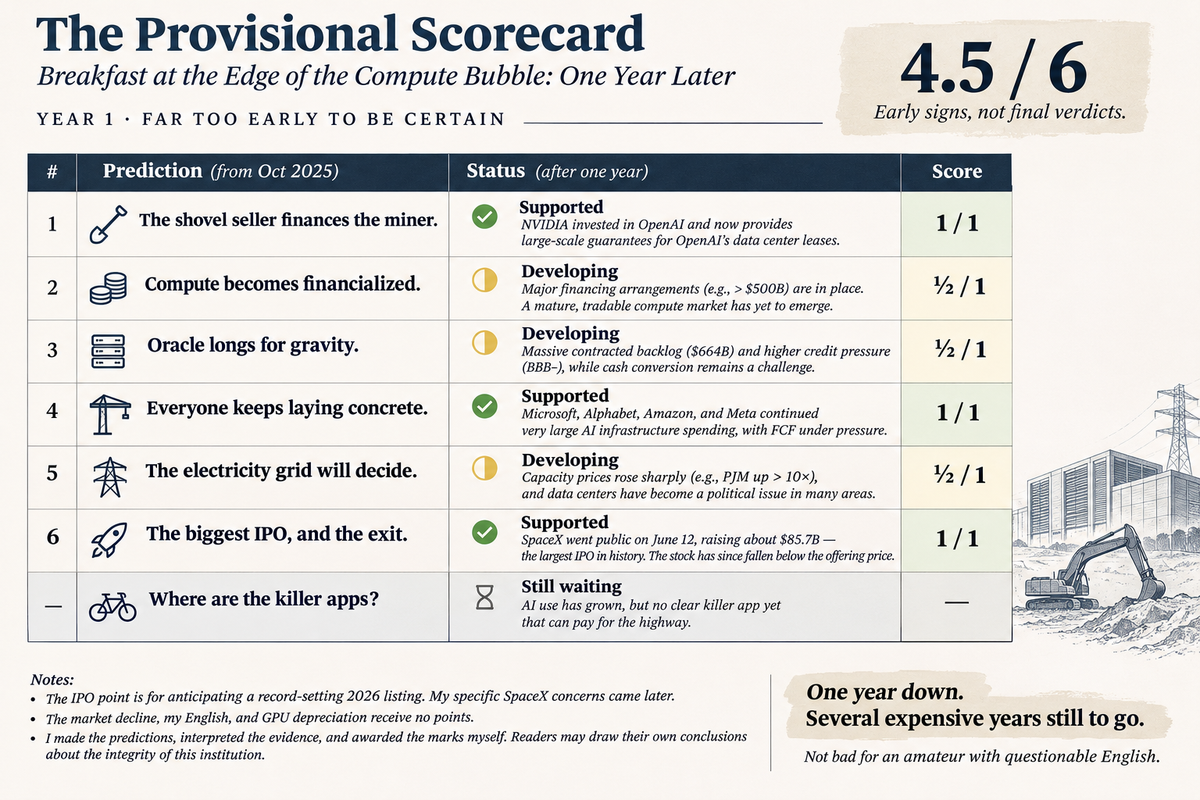
Here is my provisional scorecard. I made the predictions, interpreted the evidence, and awarded the marks myself. Readers may draw their own conclusions about the integrity of this institution.
1 - The Provisional Scorecard
YEAR 1 · FAR TOO EARLY TO BE CERTAIN
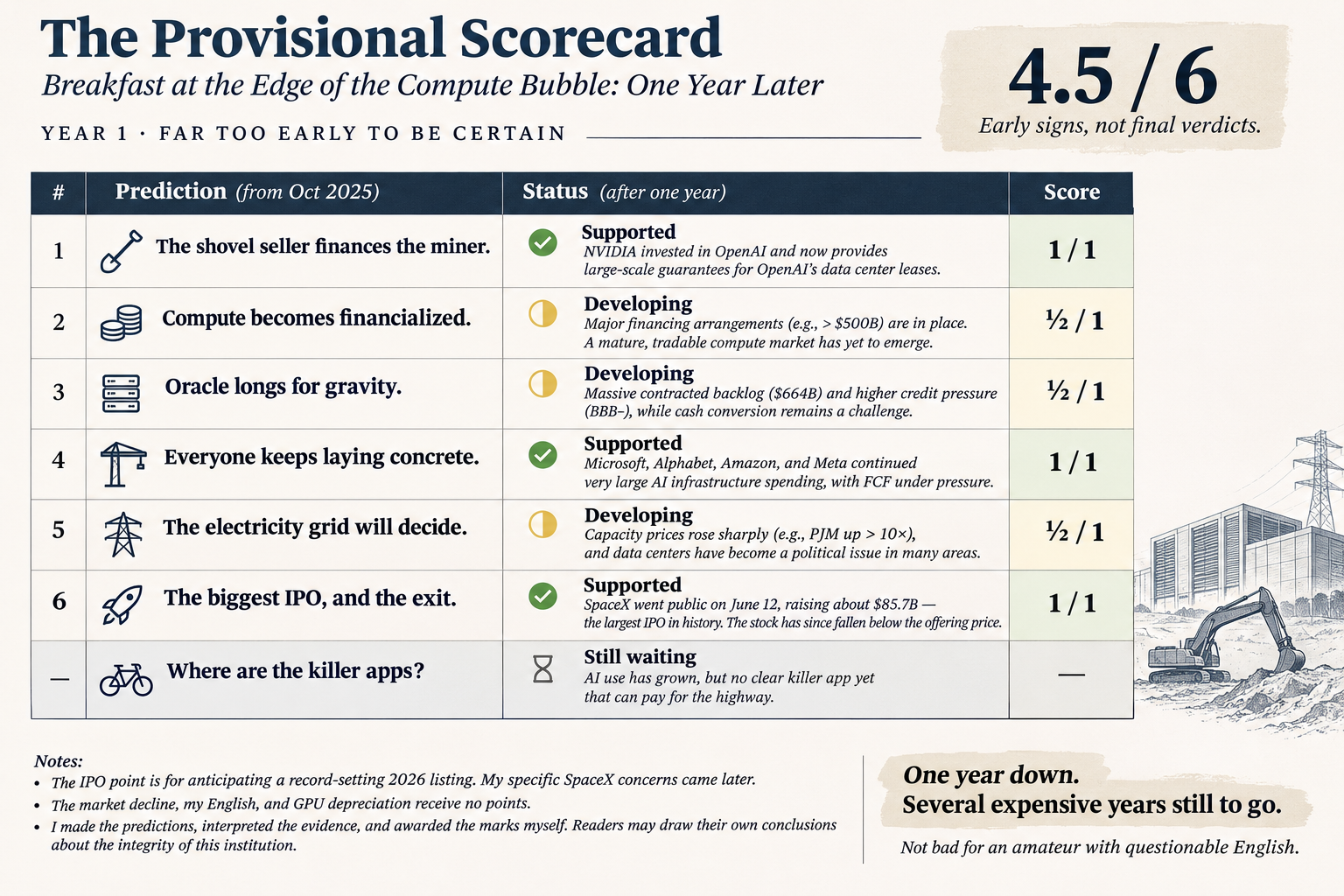
One year down. Several expensive years still to go. Not bad for an amateur with questionable English.
2 - The Shovel Seller Now Co-signs the Miner's Lease
Last year, NVIDIA announced its intention to invest up to $100 billion in OpenAI. I described the arrangement as a shovel-selling company financing the miners who bought its shovels.
The original proposal never materialized in that form. NVIDIA eventually invested $30 billion as part of OpenAI's larger financing round. OpenAI subsequently announced $122 billion in committed capital at an $852 billion post-money valuation.
Then came August. In an SEC filing, NVIDIA disclosed guarantees connected to SB Energy's Ohio data center development, involving approximately 4.25 gigawatts of IT load and NVIDIA infrastructure intended for OpenAI under twenty-year leases. The maximum aggregate guarantee obligation is $105 billion. These are contingent guarantees, effective in stages and payable only under specified circumstances. NVIDIA has not handed over $105 billion in cash.
Now consider what has happened to my little metaphor.
The shovel seller has progressed from financing the miner's purchase of shovels to helping guarantee the premises in which the miner intends to keep them. The miner still needs to find something valuable to dig up. Meanwhile, the manufacturer, landlord, financiers, and customer have acquired a remarkably intimate interest in one another's continued prosperity.
I had recognized the circle. The additional loop was beyond my imagination. I underestimated the creativity of corporate finance.
3 - Compute Is Acquiring Its Own Financial Industry
I also wondered last year whether computing capacity might eventually be financed and traded rather like electricity. Companies could buy tomorrow's compute today, perhaps hedge future prices, and leave financial institutions to manage the equipment.
In August, NVIDIA disclosed preliminary arrangements with major capital providers intended to mobilize more than $500 billion in third-party capital for AI infrastructure over time. Half a trillion dollars of prospective financing. For what used to be called buying computers.
A mature market in standardized compute futures has yet to appear. Unlike electricity, computing capacity depends on hardware generations, workloads, networking, power, and how quickly newer chips make old ones less competitive.
I expect the financial industry to find ways of packaging these complications. It has rarely lacked imagination when presented with an opportunity to create something tradable.
Someone will promise computing capacity years in advance. By the time it is delivered, the equipment may be worth considerably less than expected. There will be contracts allocating the consequences.
There are always contracts.
I would like to know who will discover that the contract has faithfully transferred the risk to them.
4- Oracle Still Longs for Gravity
I wrote Oracle longs for gravity last year. I rather liked the phrase, even if the surrounding English was struggling to keep up.
Oracle had joined the AI infrastructure race with commitments that seemed enormous relative to its existing business. Unlike Microsoft, Alphabet, or Amazon, it faced a more immediate problem financing construction while waiting for contracted revenue to become cash.
By October, credit markets had become less comfortable with Oracle's financing requirements. Its credit rating stood at BBB-, one notch above speculative grade. Meanwhile, Oracle reported $664 billion in remaining performance obligations at the end of August. An astonishing amount of contracted future business. I imagine it looks splendid in an investor presentation.
Unfortunately, contracts do not build data centers. Someone must purchase equipment, secure electricity, construct facilities, and finance everything while waiting for customers to pay.
Oracle expected only about 13% of those obligations to become recognized revenue within the following twelve months.
The credit market is already putting a price on the difficulty of getting there.
5 - The Concrete Keeps Coming
Microsoft, Alphabet, Amazon, and Meta continued spending astonishing sums on AI infrastructure throughout 2026.
Their accounting methods and reporting periods differ, so I shall resist combining everything into one spectacular total. There are already enough large numbers in this article.
The free cash flow figures are interesting enough.
Meta reported negative $2.12 billion for the September quarter, despite generating nearly $33 billion in operating cash flow. Amazon's trailing-twelve-month free cash flow was negative $42.4 billion, compared with positive $14.8 billion a year earlier. Alphabet also reported negative quarterly free cash flow, although its trailing-twelve-month figure remained positive. Microsoft remained cash-flow positive while continuing its enormous infrastructure investment.
These are exceptionally capable businesses. They can afford investments that would destroy an ordinary company. But even their resources are not unlimited, and the returns must eventually justify the expenditure.
The money is being spent now. The revenue expected to justify it may arrive years later, perhaps after several generations of hardware have come and gone.
For much of the year, investors rewarded companies for announcing more spending. Now free cash flow has become fashionable, as though someone had only recently discovered that capital expenditure requires capital.
6 - The Grid Has Acquired Voters
Last year I imagined AI models competing with towns for electricity, cooling, and water. I even suggested that perhaps July in Phoenix would settle the argument.
I was wrong about the month. The conflict, however, has become much more visible.
In the PJM electricity market, covering much of the eastern United States, the capacity auction price rose from $28.92 per megawatt-day for the 2024–25 delivery year to $329.17 for 2026–27.
Data center demand contributed to the pressure, alongside generation constraints and other market problems. Electricity markets have enough complications without my assigning every dollar of the increase to AI. Households, meanwhile, receive bills without an explanatory seminar on wholesale capacity markets.
An August survey by the University of Pennsylvania's Annenberg Public Policy Center found that 61% of Americans opposed new data centers in their own area, up from 49% earlier in the year.
By the November midterms, electricity costs and data center construction had become political questions in several communities.
I had assumed last year that households would probably lose this argument. Technology companies had more money, influence, and a compelling story about national competitiveness.
I neglected something rather old-fashioned: the people living in those households may vote.
7 - Where Do Old GPUs Go?
One subject I didn’t explore deeply enough last year: depreciation, which suggests the future may be uglier than I thought.
Highways and fiber-optic networks can remain useful for decades. GPUs age rather differently. A chip that is excellent today may become less competitive when newer generations arrive. Michael Burry has argued that some companies may be depreciating computing equipment over periods longer than its actual economic life, potentially understating expenses.
True. But, as an engineer, I find the question less certain because the useful life of a GPU depends on what someone wants to do with it. A machine no longer attractive for training frontier models may remain useful for university research, smaller developers, or less demanding inference workloads.
NVIDIA reported a $400 million charge connected to excess H200 inventory and purchase obligations during the first half of its fiscal year. One might take this as evidence of rapid obsolescence, until one reads the filing and encounters the complication of restrictions affecting the Chinese market.
Then I started wondering where the old GPUs would go: some will be scrapped. Others may become attractive to buyers who could never afford the newest equipment. Their usefulness depends on what work they can still perform, and at what cost.
Let's look at Mac mini.
Earlier this year, enthusiasm for local AI tools, including OpenClaw, helped create unexpected demand for Apple's small desktop computer. New machines became difficult to obtain, and second-hand prices rose. The older Mac minis sitting in cupboards, machines their owners had probably stopped considering particularly useful, might be perfectly capable of running a local agent.
There is something pleasing about that possibility. A little computer that ceased to impress anyone may still have work left to do. Of course, a Mac mini is a rather different proposition from a rack of commercial GPUs. But software occasionally gives old hardware a reason to exist again.
Accounting depreciation does not determine when a machine must stop being useful.
Someone, please follow those machines and see what becomes of them.
8 - The Killer App Still Hasn't Come to Breakfast
OpenAI was hardly a small company when I wrote the original. I knew ChatGPT existed. My question was never whether people use AI. It was whether the way we use it can pay for the highway.
A year later, more people are cycling. They are still cycling.
And I still haven't seen a killer app. Not yet.
Meanwhile, the eight-lane toll highway has become even more expensive. Who is going to pay the rising tolls?
An interesting observation came from TikTok CEO Chew Shou Zi on October 12. Speaking at a conference in Singapore, he noted that AI-generated videos accounted for a greater share of uploads than views. People watching only AI content remained a small, single-digit percentage of TikTok users.
I found that rather funny. We have become exceptionally good at producing something the audience seems less enthusiastic about consuming. Videos generated, tokens consumed, GPUs kept busy. The companies selling the equipment must be delighted.
Nothing against bicycles. I simply doubt they can afford the tolls.
Perhaps the killer app will arrive next year. I would be delighted to see it.
And if you think one has already arrived, tell me which one.
9 - SpaceX Went Public. Someone Is Holding the Door.
Last October, I wondered whether 2026 would bring the biggest IPO in history. I didn't name SpaceX at the time. That particular obsession developed later, and I am afraid I wrote rather a lot about it.
In April, I published Cursor Has No Moat. SpaceX Has No Cash. Perfect Match., trying to understand the proposed acquisition and where the money was supposed to come from. In May came The Landlord, The Exit, and The Ghost of Houston, where I became interested in who was preparing to leave the party and who might end up holding the door.
Then, in June, I made the mistake of doing some arithmetic over coffee. The result was SpaceX IPO Valuation: Am I Missing Something?. I checked the growth calculations twice. They did not become any more comforting.
By the time I wrote SpaceX IPO (SPCX): You're Already In, I had moved on to the share structure, lock-ups, and the possibility that ordinary investors might acquire exposure without consciously deciding to join the excitement.
Four articles about an IPO that hadn't happened yet. I probably need another hobby.
Still, the question running through all four was simple enough: who owned what, what had they paid, when could they sell, and who would eventually buy?
SpaceX began trading on June 12 at an IPO offering price of $135 per share. The offering formally closed on June 15, with approximately $85.7 billion in net proceeds after the underwriters' additional allocation was fully exercised.
The largest IPO in history.
The stock reached an intraday high of $225.64 on June 16. By November 5, it had closed at $123.62, about 45% below that high. That is also below the $135 offering price.
Even investors who acquired shares at the IPO price were sitting on a paper loss, assuming they still held them.
People who paid different prices now have very different positions. When existing shareholders eventually sell, someone must buy. That buyer may be an institution, a professional trader, or an ordinary investor hoping to own a piece of the future.
I used the image of someone holding the door before the IPO. I still think it fits.
The prospectus explains the risks. It is less successful at explaining what disappointment feels like.
P.S. The Bill Arrived Early
When I wrote the original article, I ended with the people who paid for the dot-com bubble.
I was thinking about engineers who moved their families across oceans, hoping that hard work and stock options might eventually provide a home, an education for their children, or a little financial security. Some watched their companies collapse, their options become worthless, and their families spend years recovering.
The internet eventually changed the world. The fiber networks survived, and new businesses grew out of the wreckage. Excellent news for the world. Probably less comforting to someone who had already lost a job and a family's savings.
I was thinking about those people last year. I still am.
We are barely a year into what may be a five- or ten-year AI infrastructure story. Yet some bills have already arrived. Households are questioning electricity costs. Communities are accommodating enormous facilities. Investors have discovered that buying a piece of the future can be expensive.
The bills are arriving much faster than the promised returns.
Ordinary people do not live on an infrastructure investor's timetable. Electricity bills arrive every month. Mortgages still need paying. A family cannot necessarily wait five years for an industry to discover its proper size.
The people paying today's bills cannot settle them with tomorrow's historical significance.
The number on the balance sheet is still clean. The life underneath it still isn't.
Just remember that. Again.
See you next year.