
Xiaomi Smart Band 10 Pro: A Product That Expects the Unreasonably Persistent
I accidentally made the China-market model work in the United States. This says more about my habits than Xiaomi’s design.


I accidentally made the China-market model work in the United States. This says more about my habits than Xiaomi’s design.
I am an unusual consumer, a weirdo. Let's confirm that before we move on. When I cannot return a purchase because the Pacific Ocean happens to sit between me and the manufacturer, I will try almost anything to get my money’s worth.
So, when the app claims it cannot find a device, I inspect the Bluetooth state. When it requests a permission that seems excessive, I refuse and watch what breaks. When a health sensor produces a suspicious number, I reach for another instrument. I press obscure switches to discover what they actually control.
I know I am strange. Most people have better things to do.
Consumer products are supposed to work for normal people. An Apple Watch is a useful example. Its owner does not need to understand the machinery behind pairing, notification relay, health permissions, or regional services. The system may be complicated underneath, but the complication rarely becomes the customer’s unpaid occupation.
Xiaomi, on the contrary, repeatedly handed it back to me.
Inconsistently.
The Menu Punished Me for Choosing a Valid Answer
My husband returned from a trip to China with a Xiaomi Smart Band 10 Pro for me. Mind you, we live in the United States. So when Mi Fitness asked me to select a region, I naturally chose the United States.
The option was plainly available. Nothing suggested that it was, in fact, a trick question.
Mi Fitness searched for the band and reported that it could not find it. It even offered a “Can’t find your band?” help section, which advised me to move the devices closer together, reset both, and try again. I followed the instructions.
Naturally, none of it worked.
Most consumers would take the message at face value. By then, any reasonable person would conclude that the gift was defective and give hubby a cold look. Almost no one would inspect the underlying Bluetooth state.
I am one of the few who would. Instead of giving him a harsh look, I inspected the Bluetooth connection.
The phone could see the band. The two devices had completed enough of a handshake to establish that the connection was alive. At the Bluetooth layer, the band was plainly present. Mi Fitness was refusing to acknowledge it. There had to be another error underneath the one shown on the screen.
Then I remembered my previous Xiaomi band.
I bought it before the pandemic. It connected to my phone and insisted on displaying Beijing time instead of the phone’s local time. I complained on Weibo and attracted enough attention that a later software release fixed the problem, narrowly saving the band from a permanent appointment with a drawer.
Several years passed, and apparently so did my memory.
It suddenly occurred to me that the region setting might be the real problem. What if this model could not be activated under the United States region?
Any sane person would expect Mi Fitness to hide an option the device could not use. It could also say, plainly, that the model requires the China region and invite the user to change it. “Device not found” describes a connection failure, a powered-off device, or perhaps a band that has escaped under the sofa. It does not describe hardware sitting beside the phone while the app objects to its nationality.
Then again, this was Xiaomi, the company whose previous band insisted on Beijing time while its paired phone was reporting Pacific Daylight Time.
The menu’s offer of the United States as a valid answer meant nothing. I had the poor judgment to believe it. I changed the Mi Fitness region to China. The missing band appeared.
To make a long story shorter, I will spare you the rest of the workarounds. They were unusual, they do not belong in a consumer setup guide, and success should never depend on discovering them. Stubbornness became the warranty service.
Anyone living abroad or traveling frequently should buy the international version, if there is one. Do not pick up the China-market model during a trip and assume it will settle politely into life overseas. Mine eventually worked, but the word “eventually” is doing rather more work than Xiaomi’s instructions.
My success proves that the device can be made to work. It says nothing about whether the product was designed to work.
A Region With Several Meanings
After the band connected, Mi Fitness noticed that I was abroad and using an American number. It offered to store my data in the United States. I selected the option and prepared for another argument.
The process completed smoothly.
Minutes earlier, the app had required China as my region before it would admit that the device existed. Now the cloud service was perfectly happy to treat me as an American user and store my data in the United States.
The same word, “region,” had acquired two different jobs.
Storing my data in the United States was clearly a data-governance decision, with the regulatory obligations that come with it. The cloud service understood that the device’s sales region and the region governing my data were separate questions.
Ah. So Xiaomi did know.
I do not know how the company is structured internally. I can only say that the cloud team appeared to understand the distinction, while the activation flow saw a dropdown.
The knowledge existed. It simply had not reached every screen. Xiaomi as a company obviously possesses the necessary knowledge. Some part of the company understands regional compliance is not only a consumer convenience but also a legal requirement, and can implement it cleanly.
The knowledge did not travel.
This is a governance failure: the distance between a company knowing something and making the whole product act on it. The situation was hardly exotic. People travel. Families cross borders. Customers move countries while retaining the same wrists.
Apple also sells region-specific hardware. A North American iPhone may rely entirely on eSIM, while the China-market version may use physical SIM cards. That difference affects whether the phone can serve the buyer at all, so it belongs in the purchase decision. A Chinese customer who requires a physical SIM should know before paying that a North American model is the wrong model.
Xiaomi owed its customers the same clarity. If the China-market Smart Band requires the China region for activation, the product page, packaging, and checkout screen should say so in large, unambiguous text: “China Mainland Version for China region only.”
Apple tells the buyer which version will not work before the purchase; Xiaomi waits for the user to fail without understanding the root cause. A company with global ambitions should be able to imagine this sequence without classifying the customer as an unforeseen technical event. At least it should send the right error code, or write down instructions on the box.
Humans are not trees. We have feet. We travel.
When “Other” Means Everything
Notification management offered another small investigation.
The Apple Watch and the Xiaomi band belong to different product categories. I did not expect a fitness band to reproduce full application interfaces or provide the same depth of interaction. A shortened iPhone notification is enough. The user still needs a sensible way to choose which notifications reach the wrist.
As for push notifications, Mi Fitness initially displayed a hard-coded list of more than twenty applications popular in mainland China. Most were not installed on my phone. Each received its own precise switch, giving me excellent control over software I did not possess.
The applications I actually used were grouped under “Other.”
I enabled it, then like magic, notifications from across the iPhone immediately began arriving. The original list of Chinese applications disappeared. When I returned to the settings, Mi Fitness began using the normal iOS application permission interface.
“Other” was the gateway to the actual notification relay. Other meant everything.
A normal user might never discover this. She could reasonably conclude that the band supported a collection of apps she did not own and sigh. Xiaomi had built the function and hidden it behind the wrong word.
Once notification relay worked, the band became substantially more useful. The hardware itself makes a credible case: a 1.74-inch AMOLED display, independent GNSS, message synchronization, and advertised battery life of up to 21 days under Xiaomi’s light-use test conditions.
The notification presentation remains ugly, though. Xiaomi delivers the text and thinks the work is done. Spending some time and money with a designer would be a smart investment. The information reached the wrist—apparently, that was the only milestone.
Calendar permissions exposed the same product logic from another angle.
During setup, Mi Fitness requested permission to read and write my calendar. I declined. I wanted the band to relay calendar notifications already generated by the iPhone. I had no reason to let it inspect my full calendar, and even less reason to let it modify anything.
The band has no SIM card and little independent life away from the phone. Any appointment worth creating can be entered more clearly on the phone already beside it. The band’s job is modest: display the reminder and vibrate at the correct time.
After I denied calendar access, reminders did not appear. However, once I enabled notification relay through “Other,” every calendar notification began arriving without calendar read-and-write permission.
I would love to bet one dollar that even their own designers do not know this.
The permission had been presented as a requirement. The product later disproved itself. There is something almost admirable about issuing an ultimatum and then forgetting to enforce it. Honestly, someone has to pay more attention to the product requirements.
Apple Watch owners generally do not discover basic notification behavior by experimenting with a miscellaneous category. The complexity stays inside the product, where it belongs.
An Ecosystem Looking for Its Own Product
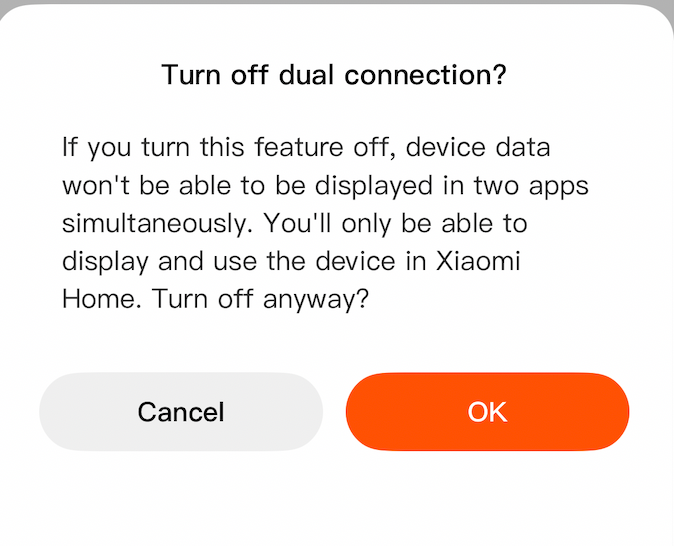
Mi Fitness includes a feature called “App dual connection.” The screen says that device data can appear in both Mi Fitness and Xiaomi Home. When I tried to turn the feature off, Mi Fitness warned me that the band would then be displayed and used only in Xiaomi Home.
I do not have Xiaomi Home installed. Had I clicked OK, Mi Fitness would have managed to evict itself from its own device.
Xiaomi Home is meant to sit at the center of Xiaomi’s device ecosystem. The Smart Band is Xiaomi’s own hardware. Mi Fitness is Xiaomi’s own fitness app. Yet the interface could not clearly explain which app controlled the band, which one received the data, or why disabling a feature inside Mi Fitness would remove Mi Fitness rather than Xiaomi Home.
I merely read the warning by playing with each and every clickable thing.
My data was supposedly stored in the United States. Mi Fitness was now suggesting that another Xiaomi app, absent from my phone, had some claim over the same device and its data. My guess is that the separation between the two services is thinner than the interface admits.
As a consumer, I should not need a hundred pages of documentation to understand an on-screen switch. When Xiaomi managing Xiaomi is this chaotic, the rest of the ecosystem is left as an exercise for the reader.
The watch-face marketplace shows the same shortage of supervision. Xiaomi offers free faces, paid faces, and subscription access. Many such watch-faces appear to come from partners. Some are clean and useful. Others treat every empty pixel as evidence of unfinished labor.
A small watch face needs minimum font sizes, readable contrast, clear information hierarchy, and a limit on how much data can be squeezed into a glance. Several faces seem determined to fit eight hundred words onto the display.
The information is all there; finding it is the exercise component. A platform this large needs an editor. It needs standards, testing, review, and the confidence to reject work that fails on the screen where it will actually live.
Xiaomi built the market, then left everyone on their own.
Ninety-One Percent, Perfectly Normal
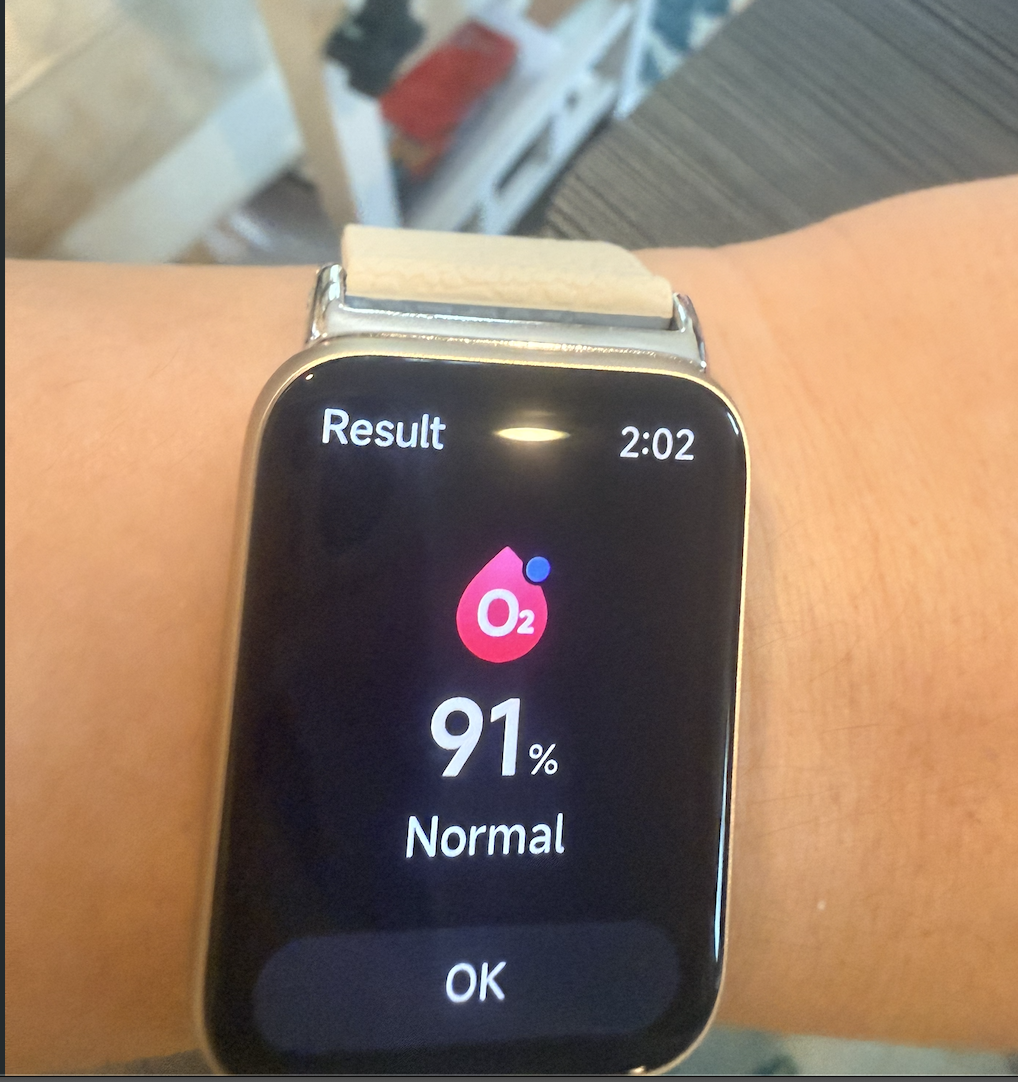
The most serious example arrived while I had influenza.
I used the band to measure my blood oxygen level. It reported 91 percent and labeled the result “Normal.” (I immediately checked with a dedicated fingertip pulse oximeter. It read 96 percent. So no, I was not in danger.)
Even pulse-oximetry results can differ from actual blood oxygen by 2 to 4 percentage points. The classification was still a product decision. MedlinePlus describes 95 to 100 percent as the usual normal range and advises contacting a health care provider at 92 percent or lower.
The product had several responsible options. It could have asked me to tighten the band, remain still, and repeat the measurement. It could have suggested confirming the result with a fingertip oximeter. It could have told me to consider my symptoms and seek medical guidance if the low reading persisted.
It chose “Normal.”
Xiaomi’s official product page says that the blood-oxygen feature is not a medical device, that its results are for personal reference, and that users who feel unwell should rely on professional equipment or consult a doctor. Well, let's just say not every consumer reads the page before using the function. That disclaimer does not license false reassurance.
My AirPods offer a useful comparison. During Apple’s hearing test, the system monitors ambient noise. If the environment is too loud, it tells the user to find a quieter place, turn off sources such as fans, or wait. The test can pause when noise rises.
The Apple device encounters uncertainty and translates it into an action. Xiaomi collected the number and apparently considered the intellectual part of the exercise complete.
The sensor made a mistake. The product manager endorsed it.
Most users will not have a fingertip oximeter waiting nearby. They may have only the band’s confident reassurance. That makes the word on the screen more consequential.
The Customer Has Done the Product Management
Nearly every success in this setup came from doing something most customers would never consider.
I inspected Bluetooth instead of trusting the error message. I selected a country where I did not live. I used additional workarounds to complete an ordinary activation. I opened an obscure switch and discovered the actual notification system. I withheld permissions to determine whether they were genuinely required. I verified a health reading with dedicated equipment.
The band eventually worked because this customer performed much of the product management.
Did anyone responsible for the product walk through every menu? Did anyone compare the error messages with the errors that had actually occurred? Did someone test a China-market device with an American account and phone number? Did anyone notice that Mi Fitness was proposing to send its own device into an app absent from the phone? Did anyone look at 91 percent beside the word “Normal” and feel a moment of professional discomfort?
Inside Xiaomi, these incidents may belong to separate teams. Activation has one owner. Cloud storage has another. Notifications, permissions, health interpretation, and ecosystem integration each have their own requirements and release schedules.
But the customer pays for all of it as one product.
Apple’s advantage is not simplicity. Its devices contain enormous complexity, but the company usually prevents that complexity from becoming a prerequisite for ownership. A normal person can handle an Apple Watch because the product has already handled many of the questions on her behalf.
Normal people should not need to become strange.
Xiaomi has the engineers, infrastructure, and market reach to build a convincing global wearable. The evidence is already inside the product. The hardware is capable. The cloud workflow can be competent. The notification relay exists. The failures appear in the handoffs between them.
The lesson existed. Xiaomi never made it mandatory.
I have liked Xiaomi for years. Other wearables have spent those years becoming more polished companions. Xiaomi has spent them enlarging the ecosystem around a product that remained where I left it.
Its ambition has traveled farther than its organization has learned to follow. The ambition shipped first.
A Recommendation for Normal People
Initially, I posted "I'd not recommend it to anyone" when I rejected the calendar request and it threatened to be useless. My verdict changed after I discovered the notification relay.
Before that, the Smart Band 10 Pro looked like a cheap watch and activity tracker with attractive hardware and long advertised battery life. Once iPhone notifications began arriving, it gained a genuinely useful role. I may eventually recommend it, after a week or two.
The decision will wait until after my upcoming trip. I have used the band for less than a day. Travel should reveal whether notifications remain reliable, the connection survives, the battery approaches Xiaomi’s claims, and the device handles time zones with greater diplomacy than its ancestor.
Mi Fitness currently has no access to my location, contacts, or calendar. The setup process established that restraint is the sensible opening position. Xiaomi can ask again when it has a clearer account of the service it intends to provide in exchange.
People who live abroad or travel regularly should buy the international version. Bringing home the China-market model may save money at the counter and recover the difference through unpaid technical support.
The Smart Band 10 Pro may yet earn a recommendation. Its hardware has made a reasonable case. The software still needs to demonstrate that a customer can live with it without becoming clever at exactly the right moment.
I am willing to be strange. The product should not require it.
Sources
- Xiaomi’s official Smart Band 10 Pro product page, including display, GNSS, message synchronization, battery-test conditions, blood-oxygen limitations, and medical-use disclaimer.
- MedlinePlus guidance on pulse-oximetry ranges, measurement limitations, and thresholds for contacting a health care provider.
- Apple Support guidance for the AirPods hearing test, including ambient-noise detection and corrective instructions.
P.S. I wrote this while watching France lose to Spain in the World Cup. I might have repeated myself here and there. Blame the Spanish team; I was distracted.