
When a Song Confuses AI: What It Reveals About the Mystery of Human Creativity
When statistical models meet subtle human creativity

When statistical models meet subtle human creativity
AI today can analyze audio with remarkable precision. It can transcribe lyrics, detect tempo, classify genres, and estimate emotional tone from acoustic features. Yet sometimes, a creative work reveals just how far machines still are from grasping the deeper, conflicting layers that define human expression.
A recent experiment provided a striking example. The same song was processed through two different services of the same AI model: one performing emotional analysis, the other generating genre and descriptive tags. Both analyses were confident, data-rich, and technically accurate. And yet their conclusions contradicted each other so sharply that the result became an illustration of something profoundly human:
Emotions are mysteries, even between people. Human creativity is full of imperfection and contradictions. So it’s natural that AI encounters the confusion.
An Uncommon Emotional Decision in the Composition
The song was recently published to YouTube as a tribute to the recent Hong Kong fire. In its discription, the artist claimed:
We offer this track with deepest respect for the suffering and the memories that cannot be replaced. We understand that in the face of such tragedy, nobody can do anything to change the loss. Instead, we seek comfort in the shared sky, in the vastness that makes our loneliness feel universal, and in the quiet hope that every moment is merely “playing with time.” Our only wish is that the community finds strength and solace in the gentle passage of time. The song is a quiet space for us to grieve together and find hope in the future.
The lyrics of the song were unmistakably sorrowful: intimate, reflective, and carrying a quiet sense of loss. But the artist made a deliberate and unusual musical choice: not to intensify that sadness through the arrangement.
Instead of using minor keys or heavy, melancholic instrumentation, the composition leaned in the opposite direction:
- C major: bright, open, and clean
- 6/8 time: a gentle, swaying rhythm that is almost dancable
- Light female vocals: airy rather than dramatic
- Minimalist piano: simple and unadorned
It was a conscious decision to let the sadness exist quietly, without overwhelming the listener. Humans understand this emotional paradox instinctively: Sorrow can feel peaceful. Longing can sound bright. Grief can carry a strange kind of calm. It is in the presence of the undeniable beauty that we humans miss our family and friends. We wish they were here, and we feel lonely without them.
But this internal emotional logic lives in the private reasoning of the artist and not in the audio features alone.
What the AI Saw — and Why the Interpretations Split
This is where things get interesting.
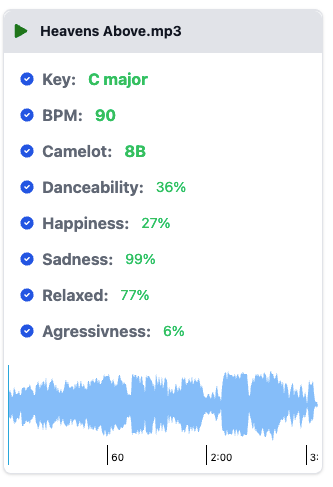
The Song Analysis service of the AI model identified the track as overwhelmingly sad, assigning it a 99% Sadness score, one of the highest possible values I’ve ever seen. It also rated happiness at 27% and danceability at 36%, capturing the song’s inner emotional tension.
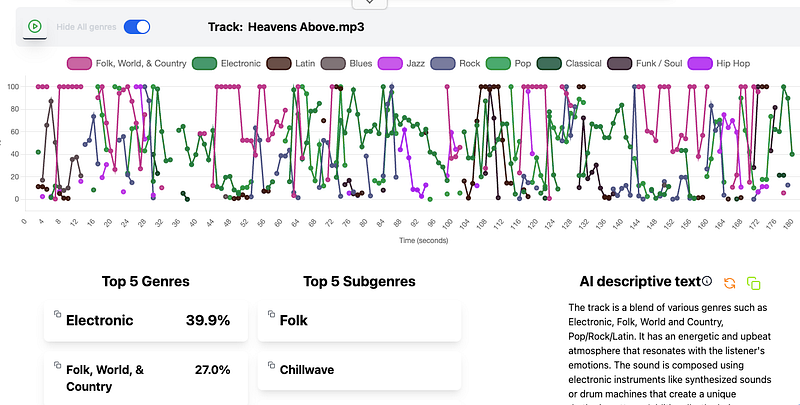
But when the exact same model was asked to perform Genre and Tag Analysis, it produced a very different reading. It confidently labeled the track as:
- Upbeat
- Relaxing
- Energetic yet soothing
- Inspiring and hopeful
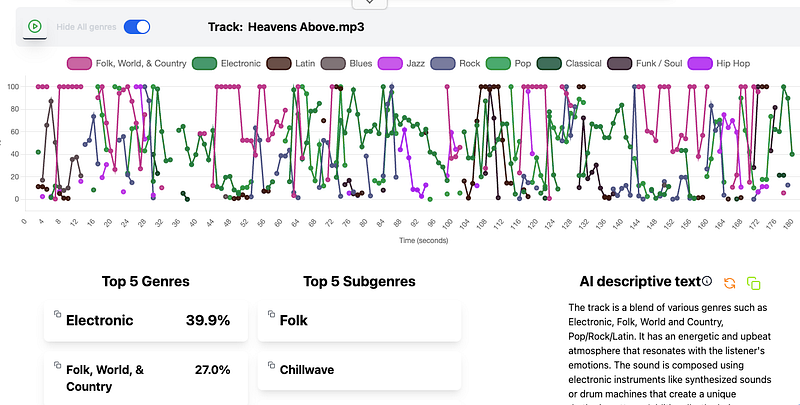
It then mapped the song to a wide spectrum of genres: Electronic, Folk, Pop, Ambient, Downtempo, even Blues and World.
The fascinating part is that both outputs were correct within their own analytical frames.
- The lyrics and vocal timbre justified the extreme sadness score.
- The key, rhythm, and arrangement justified the uplifting, peaceful tags.
What the model couldn’t do was merge these two truths into one coherent emotional interpretation, because the logic behind the contrast isn’t encoded in the audio.
It exists only in human intention, through musical expression.
AI Isn’t Failing — It’s Confronting the Same Mystery We Human Do
We humans misread each other’s emotions all the time. We misunderstand tone, overlook subtext, and miss the private emotional narratives behind someone else’s choices. That’s why human tend to have different opinions about the same piece of art.
If people struggle with this, it should be no surprise that AI, which operates only on patterns, stumbles as well.
Or maybe we can put it this way: the model wasn’t lacking the capability of recognizing patterns. It was lacking access to the meaning behind the music.
It appears emotion may not just be acoustics or metadata. It is shaped by shared memory, context, symbolism, contradiction. Through these shared experiences come the hidden logic that guides an artist’s hand that eventually delivers the final product.
None of that appears in the waveform, at least for now.
The Larger Lesson
This experiment wasn’t designed to prove the AI wrong. It revealed something deeper:
There are certain emotional responses that are simply too complex, too understated, and too personal for any system to be able to decipher them with absolute accuracy.
As a result, if an artificial intelligence model listens to a song that is lyrically depressing but musically soothing, yet the model’s own services produce two interpretations that are not consistent with one another, then this could just be a typical occurrence.
It is possible that art still contains secrets that are immune to explanation and that the emotional significance of art continues to belong, in a manner that is poetic, to humanity.
For the time being.