
The UBI Math Doesn't Work. The Math Was Always There. Now It's Arriving.
In 2018, I wrote two articles nobody wanted to think about. Eight years later, Elon Musk and OpenAI are proposing solutions. That should worry us more than it reassures us.


In 2018, I wrote two articles for fun. Eight years later, Elon Musk and OpenAI are proposing solutions. Dario Amodei gave 3% as the token tax rate. That all should worry us more, truly.
Part 1: Two Articles from 2018
In 2018, I wrote two pieces in Chinese that I thought were stating the obvious. At the time, people didn't believe the AI junk, I guess. But those articles might deserve a revisit.
The first article was about self-driving. My argument was that autonomous vehicles would hit the trucking industry first, not urban taxis. The economic case was simple and brutal. Assuming those 3.5 million truck drivers each spent about $6,000 a year eating and sleeping on the road. That spending flows into highway diners, truck stop motels, and the entire local economy of towns built around Interstate exits. Then the motels and diners that serve those truck drivers are consumers too. And that $21 billion in direct spending from truckers will quickly multiply and eventually reach a much higher number. So the idea is to never look at job loss as a local thing that can be contained at the personal level.
The second piece was about white-collar work. My argument was that automation wasn't going to stop at blue-collar jobs. AI will come for programmers, paralegals, analysts, anyone whose work was pattern-based rather than truly creative. And the new companies being built on top of AI were going to hire far fewer people than the industries they displaced. That wasn't speculation. The pattern was already there.
Let's look at US agricultural employment. It went from 38% of the population in 1900 to 2% by 2012. Factory employment followed a similar curve. But each time a wave of automation compressed one sector, fewer people were hired in the new industry. The new industries absorbed only a small fraction of the old workforce. That's structural.
Part 2: The New Companies Are Not Hiring
One thing that was clear to me back in 2018: these transitions usually won't give the old industry's workers any new opportunities automatically. There are two things going on.
The new work is usually somewhere else. A new town, a new industry, something new for the next-generation workers. Farm to factory. Factory to office. That's how it worked for a hundred years. But did the factory workers actually become white-collar workers? Maybe some succeeded in making the switch. Certainly not all of them. When I wrote the article in 2018, I did check what alternative career options existed for truck drivers. AI engineer was not on the list.
There's more to it. The new industry always tends to hire fewer people. These numbers are from 2017 when the article was written, so yes, they are a bit out of date. Meta, then known as Facebook, now has 79,000 workers. After the May layoffs, that number is going to become 71,000. So they did hire more people over the past eight years. But the argument still holds.
| Company | Era | Peak Employees |
|---|---|---|
| AT&T | Peak | 760,000 |
| General Motors | Peak | 660,000 |
| IBM | Peak | 430,000 |
| 2017 | 57,000 | |
| 2017 | 20,000 | |
| Airbnb | 2017 | 3,000 |
The platform economy already confirmed the pattern. Google replaced AT&T in economic weight while employing roughly 7% as many people. But then the new jobs were better. The economy adjusted. It always had.
Now comes the AI wave.
| Company | Revenue (2026 ARR) | Employees | Revenue per Employee |
|---|---|---|---|
| OpenAI | $24B | ~4,500 | ~$5.3M |
| Anthropic | $30B | ~2,500-5,000 | $6M-12M |
| Copilot | $400M | 94 | ~$4.2M |
| DeepSeek | $200M | 160 | ~$1.25M |
Anthropic is on track for $30 billion in revenue with a headcount smaller than a mid-sized regional law firm. Copilot does $400 million with 94 people. These are not young companies that will eventually scale up their hiring. This is what the business model looks like. We are starting to see more and more one-person companies in the Bay Area. I myself was invited to the headquarters of a few. They usually occupy a nice loft or an ocean-view house, always with big windows and multiple curved monitors. Some even have racks of Mac Minis. Fancy.
The destination that used to absorb the displaced workers does not exist this time. Truck drivers won't find jobs at Anthropic. Neither will the full 8,000 people set to lose their jobs at Meta in about a month. The new industry is not hiring them. The economics has changed.
White-collar payrolls have already contracted for 29 consecutive months as of early 2026. That's a stretch economists describe as unprecedented outside a recession. The jobs I named in 2018, paralegal, junior analyst, entry-level programmer, are now showing up in the layoff announcements.
It's happening.
Part 3: It's Families, Not Headcount
When we talk about displacement we tend to count individuals. That's undercounting the problem.
The trucking math is a clear example. 3.5 million truck drivers, and $21 billion flowing annually into diners, motels, and gas stations along American highways. Automate the trucks and the money stops. The diner closes. The motel closes. The school district that depends on property tax from those businesses starts cutting teachers. When truck drivers lose their jobs, their family loses income. So do the diner family, the motel family, and all the families counting on their spending. Even teachers are impacted.
The $168 billion the industry saves does not flow back into those towns. It flows to shareholders.
That's what displacement looks like at the family level.
And 3% of $168 billion would be roughly $5 billion, if all is recorded as net profit and pay token tax. That's about 25% of the direct spending by the truckers.
And the radius of the AI wave is much wider than trucking, because it reaches industries that automation has never really touched before. A paralegal at a mid-sized firm, or a junior analyst at a consulting firm, or maybe a programmer six years into a career that is being compressed from both ends by tools that didn't exist three years ago. On top of that, are the fresh graduates nobody is willing to hire anymore.
These are six-figure jobs. Some of them are $300,000 jobs. When those families lose that income, the math of what we need to replace it becomes very specific very fast. And it is a much bigger number than what anyone is currently proposing.
Silicon Valley will become the new epicenter.
Part 4: Andrew Yang Was Too Aggressive, Apparently.
When Andrew Yang proposed $1,000 a month for every American adult in 2020, it was considered too radical and too expensive. The economy are creating new jobs. Those lefties are just being left.
Now read OpenAI's April 2026 policy blueprint. One of the most valuable private technology company in the world just proposed robot taxes, a national public wealth fund modeled on Alaska's Permanent Fund, automatic safety net triggers tied to AI displacement metrics, and trials of a 32-hour workweek at full pay.
Then read Elon Musk's recent post on X: "Universal HIGH INCOME via checks issued by the Federal government is the best way to deal with unemployment caused by AI." I quite like the name 'High income'. It implies good medical care, food, housing, transport, everything. A "Sustainable abundance."
The people who built the technology are now proposing the safety net.
This convergence across the ideological spectrum is not a sign that the people closest to the technology have looked at the same numbers and reached the same conclusion: the existing social contract is not built for what's coming.
Part 5: Well, I Do Have Another Short Article
Two months after ChatGPT entered public consciousness, I wrote a short post on Weibo, the Chinese equivalent of X.
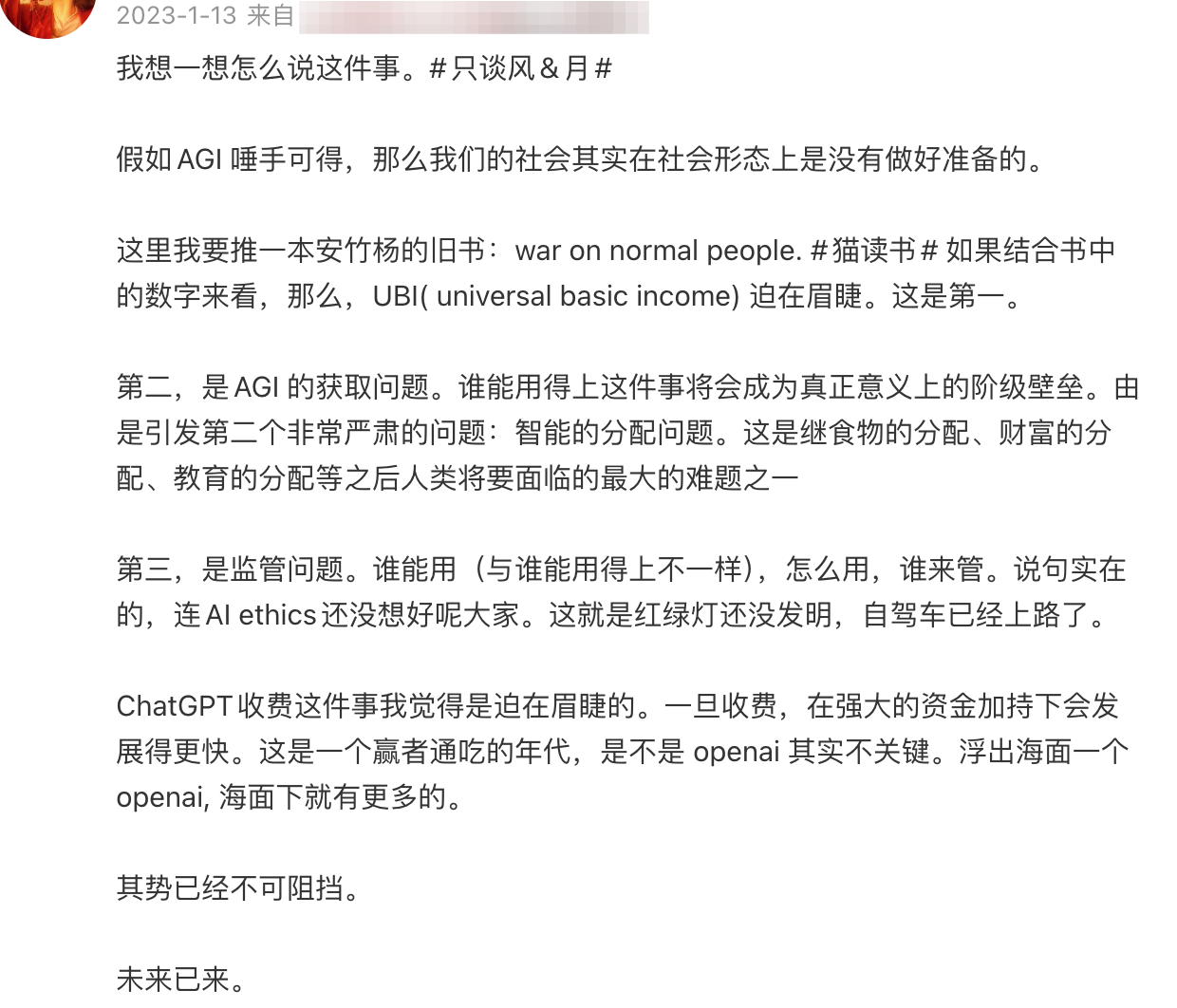
Here's what it said, translated:
I've been thinking about how to say this.
If AGI were within reach, our society is simply not prepared for it. Not with its current social structure.
I want to recommend an old book by Andrew Yang: The War on Normal People. If you look at the numbers in that book, UBI (universal basic income) is imminent. That's the first thing.
The second is the access problem. Who gets to use AGI will become the real class divide of our time. Which leads to the second serious question: the distribution of intelligence. After food, wealth, and education, this may be one of the greatest allocation problems humanity will ever face.
The third is governance. Who can use it, how it gets used, and who gets to decide. Honestly, we haven't even figured out AI ethics yet. This is like the self-driving car already on the road before anyone invented the traffic light.
ChatGPT going paid feels inevitable to me. Once there's a subscription model, capital follows, and development accelerates. This is a winner-takes-all era. Whether it's OpenAI specifically doesn't matter. One OpenAI surfaces indicates many more are swimming underneath.
The momentum is unstoppable.
The future is already here.
ChatGPT did go paid. Capital did follow. Development did accelerate. Claude, Gemini, Grok, and many others formed underneath. So I'd say the rest of that post probably deserves attention too. Specifically the part about UBI being imminent. And the part about who gets access. And the part about nobody having figured out governance yet.
Because those three problems are still unsolved. And they sit directly underneath the math we are about to look at.
Part 6: The Math Still Doesn't Close
Yang's $1,000 a month is $12,000 a year. The median US household income is around $74,000. A truck driver makes around $35,000. A paralegal $55,000. A financial analyst $85,000 and up. A mid-career software engineer $120,000 to $180,000, plus stock and other benefits.
$12,000 a year does not replace all of those. But here is the good news: it does encourage a larger family size. The issue is, as the family size grows, the funding of the UBI check will feel the pressure. Yang's number is a good starting point, except it doesn't address 'where does the money come from' issue.
OpenAI's blueprint doesn't specify a tax rate. It gestures toward shifting the tax base from payroll toward capital gains and corporate income. It is a kind of Oil Revenue for Alaskan approach. However, the public wealth fund modeled on Alaska's Permanent Fund pays Alaska residents between $1,000 and $2,000 a year. Alaska has 733,000 people. The United States has 335 million. That math is left as an exercise for all of us.
Musk's Universal High Income assumes AI productivity will outpace money supply growth so dramatically that inflation becomes irrelevant. That may be true in some future state. It is just hard to image with news on TV these days.
We already covered the 3% token tax won't be enough. But then I'd love to buy him a coffee someday. Just to sit with someone who's actually done the math and is saying it out loud. Let's say I adore him to propose 3% on revenue, not net profit. Otherwise this industry would never see net profit, maybe except Anthropic.
Even when the AI boom produces a spectacular winner, the math remains broken. Take Nvidia. In 2025, the company reported an astonishing $123 billion in U.S. pretax income, the second-highest single year of earnings in American corporate history. Yet, because of "pedestrian" tax strategies like the Foreign-Derived Intangible Income (FDII) deduction and R&D credits, their federal cash tax bill was approximately $17 billion to $19 billion.
And US social programs are funded primarily by payroll taxes. In fiscal year 2025, payroll taxes generated approximately $1.7 trillion, about 34% of total federal receipts. If AI displaces enough workers that wage income contracts, that revenue base contracts too. The programs shrink at exactly the moment demand for them grows.
While $19 billion sounds like a fortune, it is a rounding error in the context of the American social contract.
To replace the revenue lost if those workers are displaced, we wouldn't just need one successful AI company. We would need 90 Nvidias, all performing at record-breaking levels, all simultaneously, just to break even on the payroll tax alone. We aren't just missing a few billion dollars; we are missing an entire tax base.
Bottom line: Can We Replace Lost Income With a Mechanism Being Eroded by the Same Force?
A 3% token tax. A $1,000 check. A wealth fund modeled on a state with fewer people than Columbus, Ohio. These are not wrong ideas. They are right ideas at the wrong scale.
Part 7: Where Do We Go?
Eight years later, that's still the key question.
The industry being built on top of AI has clearly demonstrated that it is not labor-intensive. It does not need the displaced workers. And it is growing fast enough that by the time the policy conversation catches up, the displacement will already have compounded.
Where can the majority of people find new jobs?
The proposals now entering mainstream conversation are attempts to answer that question with money instead of a destination. That might be a honest approach. If the destination genuinely does not exist, redistribution is the way to go.
But the amounts being proposed are calibrated to a transition, not a permanent structural shift. They assume the labor market rebalances. That new job categories emerge that we cannot yet name, like "social media manager" before Facebook.
Maybe. The history of automation has surprised pessimists before.
But the replacement ratio has gotten worse with every wave. Fewer farmers replaced by fewer factory workers replaced by fewer platform workers replaced by a few thousand people at Anthropic. At some point the curve stops being a transition and starts being a new shape.
The optimist tells us that AI-driven productivity will allow small businesses to flourish and hire. This ignores the circular nature of an economy. Productivity is a measure of supply; payroll is the engine of demand. When we automate the latter to optimize the former, we are effectively building the world's most efficient tools to sell products to a ghost town that used to serve the truckers. A small business cannot 'sustain itself' on efficiency alone if its customer base is an analyst who just got replaced by the same API the business is using.
The fact that OpenAI published that document in April 2026, and Musk posted what he posted, tells us they think we are really close to singularity. They are not proposing temporary measures. They are proposing a redesign of the social contract.
So, let's pretend money is the only thing people need at this point. Let's forget hope, fulfillment, sense of belonging... all of those things and focus on money only. That's the most urgent conversation, and the numbers need to be much, much larger.
And we had better move fast.
p.s.
Now, this is the most difficult part. I am not sure I want to say this, but let's put it out there anyway.
When you read this article, do not only think about yourself. Not just what's going to happen to me if the unspeakable happens. Think about your neighborhood. What happens if the unspeakable happens to 50% of the families on your street? That is the real question. That is the radius.
And, if you are in high-tech, rest assured that you are at ground zero. You do want to strengthen your safety net, reach out to your network, and focus on enhancing transferable skills. Start with the 180 Days exercise, NOW.
Live long and prosper.