
The Jensen Huang Affair: Irresponsible Guesses
Three suspects. Everyone has their own reasons. Nobody needs a plan.

Everything that follows is irresponsible personal speculation. Believe it at your own risk.
Everyone knows I love novels. Detective novels, especially.
After years of lurking in Silicon Valley, however, I have found the local material rather disappointing. Ordinary people having ordinary problems. Very little room for the imagination.
Finally, something worth investigating has happened right under my nose. I am not passing up this opportunity.
Over the past week or two, Silicon Valley's darling, Jensen Huang, has suffered a rather impressive series of revelations. National security, extramarital affairs, a securities lawsuit, a board investigation, and possibly the loss of his job. Any competent fiction editor would have told the author to slow down. Nobody would believe so much could happen to one man in a week.
I wrote about Huang's rather spectacular mishandling of the situation in my previous essay. I thought that was quite enough. Then another alleged affair surfaced.
Well, now I have no choice. Time to investigate.
Who did it? Why?
I have three suspects.
A disclaimer: we are playing detective fiction here. I am going to speculate rather freely. If I get things wrong, that's my problem. If I get them right, please don't assume I have inside information.
Now, let's get on with it.
The Timeline
This story actually started in 2025.
October 9, 2025. The New York Times published an investigation into Megaspeed, a Singapore-based data center company suspected of helping restricted Nvidia chips reach China. The article mentioned the social connections between Jensen Huang and Alice Huang, an executive associated with Megaspeed. Nvidia's responses to this reporting would later appear in a securities lawsuit.
October 29, 2026. The Times reported suspicions surrounding Alice Huang's background and a possible Chinese intelligence effort targeting Jensen Huang.
November 5. Three Republican House committee chairs requested a private briefing from Huang. Congress was already interested before he admitted anything about his marriage.
November 6–7. The Times and Financial Times reported intelligence assessments suggesting that Alice Huang might have been recruited by Chinese intelligence. The Financial Times introduced a particularly interesting word: romantic.
China denied the espionage allegations. They have not been independently established, and Huang has not been accused of participating in espionage. Axios summarized the reporting.
November 8. Huang published an email to Nvidia employees, admitting that he had been unfaithful to his wife and apologizing to his family, employees, and shareholders. He also promised to cooperate with a national security investigation.
Nvidia was considerate enough to publish the email in its official newsroom, allowing people like me to study every word.
The board issued its own statement, announcing an independent investigation while expressing confidence in Huang.
November 9. A securities class action complaint was filed against Nvidia and Huang in the Northern District of California. The stock fell 4.27%. TechCrunch reported on the race among securities lawyers to sue Nvidia. The crisis communications people were presumably still recovering from Sunday. The lawyers had already arrived.
November 10. Nvidia's independent directors retained former federal prosecutor Joon H. Kim and Wachtell, Lipton, Rosen & Katz to conduct the investigation.
November 11. Another Times report. Another alleged affair. This time with an Nvidia executive who reports directly to Huang.
And the board was reportedly discussing whether Huang should remain CEO.
From an alleged affair to national security, securities litigation, and the possible removal of one of the most important CEOs in the technology industry.
In less than a week.
I can work with that.
Suspect One: What a Coincidence!
Both major stories about Huang's alleged relationships came from The New York Times.
Interesting.
News organizations know how to release a good investigation in stages. One exclusive, then another. Keeps the readers interested, keeps the competition miserable.
Suppose the reporters already had much of the material about the second relationship. They might have planned to save it for later. Then Huang suddenly confessed on November 8, removing much of the suspense from the first story.
Oops. Better publish the next one before the news gets old. Or perhaps new sources came forward after the confession. We don't know. I am simply enjoying the possibilities.
The second story had a quite curious effect. The first relationship involved national security suspicions. The second allegedly involved a subordinate. Put them together and the public might arrive at a much simpler explanation.
Oh. He is just a womanizer.
He committed what Jackie Chan famously called “a mistake all men make.” BTW, Huang once suggested that Jackie Chan would be the perfect actor to play him in a biopic.
The second revelation could make the first relationship seem less exceptional. Perhaps this was just another affair, rather than evidence that Huang knowingly participated in anything involving Chinese intelligence.
Meanwhile, the second story creates an entirely different problem.
A direct report? At Nvidia? And nobody knew?
The same revelation might help him in one direction and hurt him rather badly in another. As for the journalists, their motives are simple enough. There is news to report, preferably before anyone else reports it.
Suspect Two: The Silent Refusal
In detective fiction, pay attention to who speaks. Then look at who hasn't said a word.
If this were an Agatha Christie novel, I would be tempted to make Mrs. Huang the ultimate mastermind. To be clear, this is a character in my novel. I have no evidence that the real Mrs. Huang has arranged, disclosed, suppressed, or influenced anything.
Over the past few days, I have seen a great deal of material about Alice Huang. Background investigations, AI-generated videos, and, inevitably, comparisons between the two women's appearances.
Quite an ugly spectacle.
The alleged mistress is said to have lost morally but won in attractiveness. The wife, who is the person betrayed, is somehow also declared the loser because she is older. The husband gets to have the affair. The women get graded.
And I suspect quite a few people are quietly hoping Mrs. Huang will be sensible and consider the bigger picture. Think of Nvidia. Think of the shareholders. Think of the family fortune. Her wealth is closely tied to her husband's. If Nvidia keeps doing well, she benefits too.
Be reasonable, dear. There is so much money involved.
But once the numbers reach tens of billions, I begin to wonder whether people are still doing arithmetic or merely worshipping it.
Suppose, in our fictional scenario, that she could leave the marriage with $80 billion, dump the disloyal husband, and start a new life. Why should she continue maintaining her husband's public image so that he and everyone else can make even more money?
What exactly is she supposed to buy with the next billion that she cannot buy with the first eighty?
In my novel, Mrs. Huang has spent decades keeping things together. Family, appearances, social obligations, all the invisible work that allows a powerful man to devote himself to being powerful.
One day she decides she has had enough.
She doesn't call a journalist. She doesn't organize a conspiracy. She doesn't even need to divorce him. She simply stops doing the things everyone has assumed she would always do. Now people have a problem.
She can stay or leave. Speak or remain silent. Make a decision today or next year. At that level of wealth, she has rather a lot of choices.
And perhaps that is the truly inconvenient part. Everyone has been calculating what is best for Nvidia, for the shareholders, for Jensen.
Has anyone asked what is best for her?
Perhaps she did nothing. The astonishing part is how much she may have been doing all these years.
And people still expect her to swallow the humiliation and clean up the battlefield.
Suspect Three: The Separation
Now the board of directors.
This is where I become genuinely interested.
I have already written about Nvidia's peculiar management structure, so I won't repeat the whole argument. Huang has roughly 60 direct reports. Information circulates freely; final judgment remains heavily concentrated in one man.
It has worked brilliantly, until the problem is something he doesn't know how to handle.
Replacing Huang would be enormously expensive. I suspect Nvidia may be even more dependent on its founder, in this particular organizational sense, than SpaceX is on Elon Musk. The company has superb engineers, outstanding technology, and an enormous ecosystem. But the way decisions are made has Huang written all over it.
He leaves, and Nvidia may have to become a very different company.
So why are directors already being forced to contemplate it?
Two things: the November 8 email and the November 9 lawsuit. And I must say, that email has done an impressive amount of damage.
I said in my previous essay that Huang had opened Pandora's box. What astonished me was the way he combined his personal apology, his obligations to employees and shareholders, national security concerns, and the board's investigation into one corporate communication.
He might as well have written: I am Nvidia, and Nvidia is me.
In the good years, that identification was a tremendous asset. When Huang's personal judgment becomes the subject of investigation, things get rather more complicated.
One word: exposure.
His personal exposure had acquired a very efficient route into the company. And he apparently had professional help, and we still got the email.
Then came the lawsuit.
I went through the 17-page complaint filed on November 9. The case is Kistenmacher v. NVIDIA Corporation et al., No. 5:26-cv-13448. The plaintiff accuses Nvidia and Huang of making materially false or misleading statements about Megaspeed. The claims invoke Sections 10(b) and 20(a) of the Securities Exchange Act and Rule 10b-5.
One word caught my attention: scienter. The complaint argues that Huang's scienter can be imputed to Nvidia. Nothing particularly exotic there. Imputing an executive's state of mind to the company is standard fare in securities litigation.
What interests me is the bridge the complaint tries to build: from a personal relationship, through a customer already under export scrutiny, to Nvidia's own public statements about that customer.
Remember the earlier statements?
Nvidia said it had found no evidence of restricted chips being diverted. Its spokesperson described Huang's interactions with Alice Huang as ordinary customer contact. Huang himself said Nvidia's business with Megaspeed was normal.
‘Normal’. ‘Not unusual’.
Nothing to see here.
The email deserves another look, because it gave the plaintiff two rather useful things.
Before that weekend, the alleged romantic relationship had largely been described through reports citing sources. Huang publicly admitted infidelity. His email did not name Alice Huang, but contemporaneous reporting said he had acknowledged the relationship to the board. The story now had rather firmer footing.
And it supplied a date.
The complaint has a section titled “The Truth Begins to Emerge.” It begins with November 8: the board announcing an investigation, the Times reporting Huang's acknowledgment, the public apology. Nvidia fell 4.27% on the next trading day. The lawsuit arrived that same afternoon.
What fascinates me is that Huang, while trying to contain a scandal, appears to have supplied some rather useful material for the next stage of it. And all this through the company's official newsroom.
Quite an achievement.
Now imagine being on Nvidia's board: I joined the board of a great technology company. I did not sign up for this.
The independent directors are not defendants in this complaint. Still, there is now a complaint to answer, an independent investigation to supervise, and the possibility of more lawsuits or regulatory scrutiny. Nobody knows where the next revelation will come from.
And then, on November 11, the second alleged affair. This time, a direct report.
Well, Intel CEO Brian Krzanich resigned in 2018 after a consensual relationship with an employee was found to violate company policy.
But the most interesting detail in the Times report was the NDA.
According to people cited in the report, Huang and the executive were seen being affectionate at a San Jose hotel during Nvidia's GTC conference in March. Someone recorded the interaction. Huang's security personnel allegedly intervened and asked the witness to sign a nondisclosure agreement.
Now people really want to know who prepared it. Who authorized security to approach the witness? Was Legal involved? HR? Did anybody tell the board? How many people knew? How many were supposed to know? How many had decided it was safer not to know?
I can practically hear the boardroom conversation.
The truly frightening possibility is that actions taken today to protect Huang could eventually be used to question the board's own oversight.
That changes the arithmetic.
For years, protecting Huang and protecting Nvidia may have seemed almost the same thing. His leadership was central to the company's success. Investors trusted him. Employees trusted him. The board trusted him.
Now each expression of trust comes with a price, and the price may keep changing.
Removing him would be costly and wouldn't erase whatever liabilities the company may already face. But the company must be capable of investigating him without his help in deciding what the investigation is allowed to discover.
The board can wait for the investigation before deciding whether to replace Huang. It cannot wait until the investigation is over to establish its independence.
Closing Argument: Everyone Has a Motive
So, our three suspects.
The journalists have stories to publish. Mrs. Huang, in my Christie novel, may simply decide she no longer wishes to provide free crisis management services. The board has begun recalculating what it costs to keep protecting Jensen Huang.
They need not coordinate. They need not even like one another.
And what an unfortunate time for Huang to encounter all this.
The United States and China are fighting over technology and national security. American politics has become increasingly hostile and unpredictable. AI valuations make some investors euphoric and others nervous. Silicon Valley has begun asking whether the enormous sums being poured into AI infrastructure will eventually produce returns worthy of their price tags.
Nvidia sits in the middle of everything. Its chips are central to the AI industry. Its exports have become geopolitical issues. Its stock represents an extraordinary concentration of investors' hopes. And Huang is Nvidia, or so everyone has been encouraged to believe.
Politicians have their own calculations. Regulators have their duties. Investors have their money. Competitors have their interests.
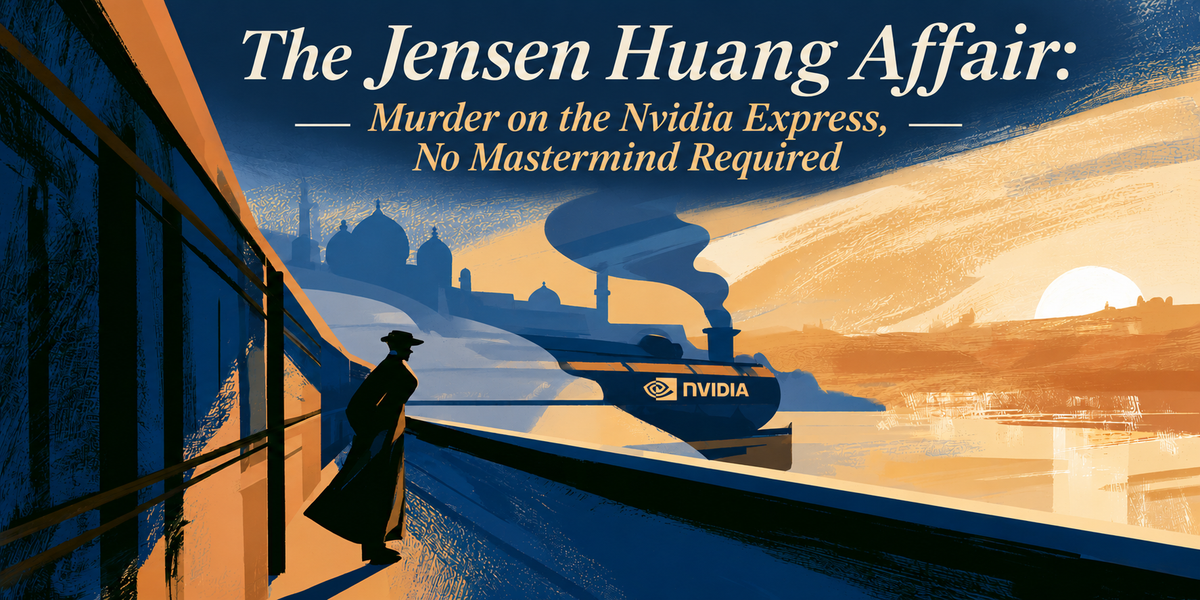
If this were a Christie novel, the detective would walk through the railway carriage and find that nearly every passenger had a motive.
In Murder on the Orient Express, everyone took a turn with the knife.
Reality can be more absurd.
What I really want to know is whether the people who once had excellent reasons to protect Jensen Huang still have reasons to keep doing so.
Perhaps nobody arranged any of this.
Perhaps everyone just did a little arithmetic and discovered something more important than protecting Jensen Huang.