
Jensen Huang and the Art of Knowing What You Don't Know
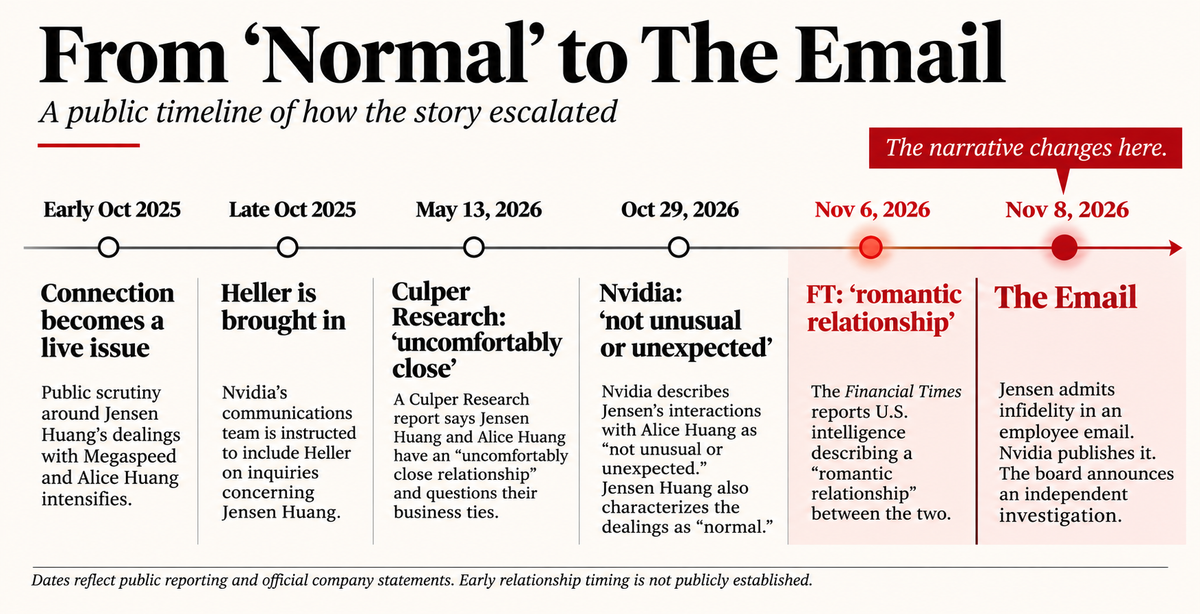
Normal. Normal. Romantic. Then a corporate confession. Jensen Huang's handling of a personal scandal may have opened Pandora's box, exposing an uncomfortable weakness in Nvidia's celebrated management model. An exercise in industrious folly.

Everything that follows is irresponsible personal speculation. Believe it at your own risk.
When Jensen Huang's November 8 email appeared, I was astonished. My published comment was that Nvidia's legal and PR teams could use a little seasoning.
Why? Because the email opened Pandora's box, creating unbounded exposure that Huang will have to deal with for years to come.
And the thing is, he did it himself.
Having watched the subsequent developments, I see no reason to revise my initial opinion.
Normal, Normal, Romantic
The sequence is rather revealing.
In late October, when reporters asked about Jensen's relationship with Alice Huang, an executive associated with Nvidia customer Megaspeed, Nvidia described their interactions as "not unusual or unexpected." Jensen himself called the dealings "normal and not unusual."
CEOs meet customers. Fair enough.
By November 6, both the New York Times and the Financial Times had reported that US intelligence identified Alice as a Chinese spy. The underlying intelligence hadn't been released publicly. The suspicions were hardly new, but the atmosphere had become considerably more interesting.
Then the FT introduced one rather consequential word: romantic.
Two days later, Jensen acknowledged his infidelity in an email to Nvidia employees. Nvidia thoughtfully published the email in its own newsroom. That's when a normal person (a.k.a. me) got to read the response line by line.
The national-security concerns had been around for some time. Megaspeed was already under scrutiny over suspected chip smuggling, and Nvidia had been dealing with those questions. The new variable was romantic.
I can imagine two perfectly respectable textbooks at work. In late October, the lawyers may have favored a narrow description of business interactions, avoiding unnecessary admissions. Then someone with a journalism or crisis-communications background may have decided that the FT wouldn't print romantic without compelling evidence, and advised Jensen to get ahead of the story.
A newspaper's confidence in publishing an intelligence assessment, incidentally, says remarkably little about what it can independently prove.
Perhaps an apology draft had been prepared months earlier, ready for deployment if some predetermined condition arose. Perhaps the weekend brought a sudden change of heart. I wasn't there. I can only guess.
What I do know is that Nvidia successfully turned a personal admission into an official corporate statement, complete with references to shareholders and national security.
Quite an achievement.
Consider the surrounding circumstances. Jensen had spent much of the previous two years personally lobbying Washington to ease restrictions on Nvidia's chip exports to China. He had developed unusually direct access to President Trump and become an important voice in American AI policy. His arguments, however controversial, were recognizable as commercial advocacy.
Then romantic entered the public record.
The same lobbying, the same meetings, and the same personal access now invited a rather different set of questions. Congress was already asking questions before the email. Jensen's confession offered a new lens through which to examine years of dealings with China, Nvidia's earlier statements, Megaspeed, and the people who had known about the relationship.
An extraordinary amount to set in motion while trying to apologize for an affair. One might have hoped for a little more sangfroid.
And here's another detail. On November 9, WIRED reported that Heller, a crisis-communications firm with considerable experience handling personal scandals involving powerful men, had been involved in Jensen's communications since at least October 2025.
A year earlier.
I don't follow celebrity gossip particularly closely, even when the celebrity runs Nvidia. But I had been wondering which business school had supplied this splendid crisis-management playbook.
"Probably not Wharton," I told a friend who was filling me in on the details.
It turns out actual professionals were involved. Suddenly a more interesting question emerges: what exactly had everyone been planning for during that year?
Actually, fire them and hire anyone with sense.
Sixty Direct Reports
Jensen's management philosophy has fascinated me for years.
In a 2024 conversation with Patrick Collison, Jensen described having about 60 direct reports. He dislikes one-on-one meetings and prefers a remarkably flat organization in which information travels broadly. Problems are discussed with the relevant people in the room, rather than passed through elaborate hierarchies.
For engineering, I can see the attraction. Jensen knows the technology intimately, can challenge assumptions at considerable depth, and wants everyone working from the same information.
Nvidia also has its famous Top Five Things email system. Employees regularly report what matters to them, allowing Jensen to detect weak signals throughout the company. He deliberately keeps his own Top Five private so that employees won't simply mirror his priorities.
Clever. Although employees hardly need a published list to discover what interests their boss.
They can observe his questions, his reactions, the subjects he pursues, and the matters on which he demands another explanation. People are good at this. Particularly people who work for exceptionally successful founders.
The information channels are flat. The gravity remains in one place.
I've attended enough cross-functional executive meetings to recognize another problem. The participants are often highly competent, each within a field whose risks and conventions the others only partly understand. Discussion can become tortuous because good experts are understandably reluctant to accept judgments they cannot evaluate.
Then come personal loyalties, competing budgets, wounded sensibilities, and the touching desire to have one's objections duly entered into the record. Do I really want to endorse this? Perhaps I should register a concern, just so nobody can say I didn't warn them. The possibilities are endless.
I've sat through enough of these meetings. I wouldn't put much faith in that as a decision-making mechanism.
Now put Jensen above the whole arrangement. For decades, his extraordinary instincts have been rewarded. He is accustomed to being the person who understands the problem better than anybody else.
An admirable qualification for designing GPUs.
What happens when the subject is Washington, intelligence, corporate governance, or a personal scandal with national-security implications?
The structure amplifies the final judgment while attenuating the very expertise that should inform it.
Who Manages the Gaps?
Consider the people around him.
Tim Teter has been Nvidia's general counsel since 2017 and is one of Jensen's trusted lieutenants. Before Nvidia, he spent more than two decades at Cooley, principally litigating patent and technology matters.
Having a patent-litigation specialist in the legal leadership of a Silicon Valley technology company is perfectly ordinary. Around here, intellectual-property disputes are practically a cottage industry.
Then came Bloomberg's November 9 report about Teter's contacts with the US Commerce Department. In late summer 2025, Teter reportedly called Commerce Under Secretary Jeffrey Kessler to ask whether the Bureau of Industry and Security had participated in Singapore's detention of Alice Huang. He subsequently contacted BIS investigators seeking a meeting, referring to Kessler's permission.
In patent litigation, asking direct questions and pressing for answers are familiar tools of the trade. Washington operates by rather different rules.
Knowing whom to call is access. Knowing what not to ask is judgment.
He went looking for information. Now his own inquiries are part of the story.
Then there is Mylene Mangalindan, who oversees Nvidia's communications and previously worked at the Wall Street Journal and the Brunswick Group. Anna Soellner, who brought experience at Reddit and in Washington, departed in October. Unfortunate timing. I wonder what she might have done differently.
Nvidia also hired Bruce Andrews in June. Andrews is a genuine Washington insider, a former deputy secretary of commerce who subsequently led government affairs at Intel. His title at Nvidia is Chief External Affairs Officer.
According to Reuters, he reports to Teter.
Interesting.
Nvidia has assembled considerable expertise. Teter himself has become an important figure in the company's Washington strategy. But a reporting structure tells you something about how expertise is organized, and perhaps about whose judgment gets the last word.
Legal understands legal. Communications understands media. Government affairs understands Washington. Each function has its own instincts, professional assumptions, and definition of a good outcome.
Someone needs to recognize when those definitions conflict.
A more conventional hierarchy would at least designate someone to reconcile those perspectives. Someone would own the process, produce a considered recommendation, and be answerable for it afterward. There would be a name attached to the judgment, which is generally useful when things go wrong.
In an exceptionally flat structure, everyone manages their own domain. Jensen (micro)manages everyone.
So who manages the gaps?
There is a question I sometimes ask people: Would you tell your boss no?
In my experience, the real difficulty is rarely finding someone willing to disagree. It's giving specialist judgment enough authority to survive a discussion among people who do not fully understand the specialty.
I've seen meetings where exceptionally knowledgeable people spent hours talking past one another. Eventually someone senior made a decision. The room was relieved. Whether the decision had benefited from all that expertise was another matter.
A founder with 60 direct reports is particularly exposed to this problem. His direct involvement is the mechanism that makes the organization work. It can also become the mechanism through which unfamiliar risks are badly translated.
I remember a management exercise from early in my career. We were divided into two rooms: soldiers on a simulated battlefield and senior executives directing operations. Communication was limited to one written note every few minutes.
The soldiers reported the situation. We executives deliberated and sent instructions. By the time our brilliant orders arrived, the battlefield had moved on. We were perpetually two steps behind.
The instructor told us about the best-performing executive team he'd ever seen. Its members sent the soldiers a single instruction: "You guys do whatever is needed."
Then they went to a bar.
I happen to know one of those shameless executives. A brilliant fellow, incidentally.
In a crisis involving a CEO's private conduct, a public company, Washington, and intelligence allegations, I'd expect corporate lawyers, the CEO's personal counsel, communications specialists, government affairs, and appropriate outside advisers to bring quite different perspectives. The trick is giving each of them room to do their job and making sure someone understands what the others are missing.
Nvidia's independent board members have now retained Joon H. Kim and Wachtell, Lipton, Rosen & Katz to conduct an investigation.
A sensible development. The committee's oversight, the investigation's scope, and its eventual conclusions will matter.
Still, I wonder where this cross-disciplinary judgment was when the email was being considered.
Savoir-Faire
Which brings me to a different question. Does Jensen have a trusted advisor?
I mean someone independent enough to tell him he's making a dreadful mistake. An executive who reports to Jensen, however accomplished and loyal, occupies a rather different position.
There are people around Silicon Valley who have lived through Washington at its most byzantine, survived antitrust battles, and learned the peculiar hazards of mixing corporate interests with national politics. Jensen surely knows some of them.
Does he have a few he can call? Better yet, are there people who would pick up the phone themselves when they read the news? I asked the same question about another founder in June.
Sometimes the most useful person in the room is someone who can ask, "Jensen, what the hell are you doing?"
Even a team of excellent advisers can share the same blind spots. There's no particular comfort in having 60 people agree with you if none of them recognizes the problem you're actually facing.
Savoir-faire (a.k.a. worldly nous) is the expression I was looking for.
I wrote about the limits of Jensen Huang's engineering worldview last month, asking what happens after the information arrives. I even called it CEO compression. I didn't expect the sequel quite so soon.
I'd almost forgotten how clever I was. How remiss of me.
Jensen's technical and commercial judgment has built one of the most extraordinary companies in history. Nvidia's influence now extends into national industrial policy, international diplomacy, security, and the internal politics of Washington. These are worlds with conventions that don't reveal themselves merely because you're rich, brilliant, or accustomed to getting your way.
A company can grow into these worlds considerably faster than its founder and his lieutenants acquire the judgment to navigate them.
There is an occupational hazard in being right for so long. Your successes accumulate into a worldview, and eventually the worldview begins to look like the explanation for all your successes. The people around you have spent years seeing it vindicated.
Then something unfamiliar comes along.
For this episode, crisis advisers had apparently been involved since the previous year. By November, there was an official company statement, a public confession, congressional scrutiny, and an independent investigation.
An impressive amount of execution.
Where was all that sophisticated judgment a year ago?
Oh, right. Busy managing the gossip.
That's what I'd call industrious folly.
Apparently, Nvidia's market capitalization has grown considerably faster than its savoir-faire.
Normal. Normal. Romantic. Then an extraordinary corporate confession.
The wildly inconsistent handling of this affair has exposed the soft spot in Jensen's management model. Expertise is distributed throughout the organization, while the ultimate judgment remains concentrated in one man. That arrangement has worked magnificently when Jensen knows the terrain.
This time, he didn't.
P.S. Playing dumb won't save him. Find the right people, quickly.