
J. Robert’s Last A-Bomb
On the silence that followed the first explosion and never really ended
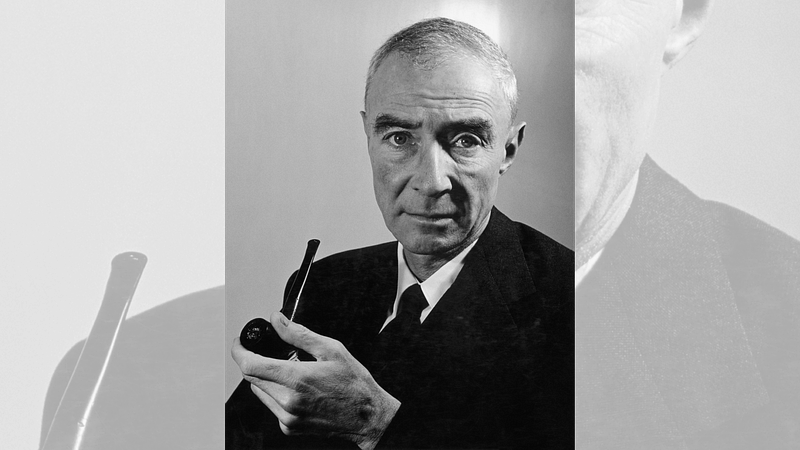
I watched the movie Oppenheimer the other night. I watched the movie in theatre when it first came out. Impressive movie. At the time, it wasn’t the atomic light, or the sound that arrived too late that stuck with me. It was the deep, still silence when everything appeared to stop existing for a time. That quiet was very loud, very loud, and very loud.
So I thought I’d watch it again, and I was hypnotized by the silences (again).
I noticed when Einstein left the pond, there was this very similar stillness. The sky was old and exhausted, the water motionless. It was almost the same quiet that followed the bomb, but maybe more so. That’s the quiet came from two extraordinary men mutually understood the future was changed forever.
I thought, maybe those two distant moments are the same silence stretched across time. It begins at the first chain reaction we created and never really ends, because we can’t take it back.
The Innocence was lost.
History always prefers its heroes refined, and narratives fit seamlessly into textbooks. Well, Oppenheimer was never that type of individual.
He was excessively astute and paradoxical. He comprehended the dual significance of possessing something both sacred and scary simultaneously. In 1954, when the authorities accused him of disloyalty and confined him to a small room to revoke his clearance, I think he would have anticipated the outcome.
How could he not?
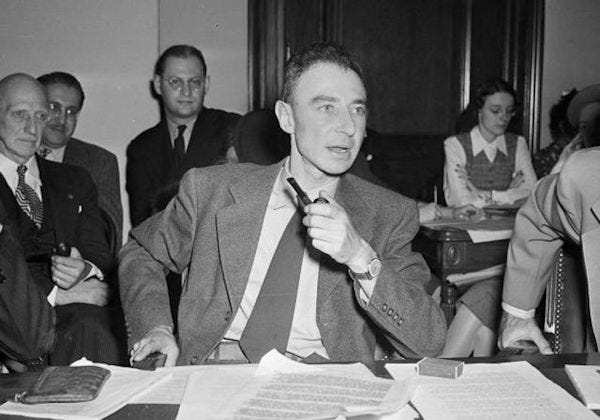
He entered the room regardless. Maybe a part of him saw that history is not defined by triumph but by the legacy one leaves behind. Perhaps that is what he intended when he stated, “People will study the record of this case and reach their own conclusions. I think there is something to be learned from it.” [6]
He was not self-defending in that room. He was documenting history. He was ensuring that the white wall of history would not remain unmarked.
The Weight He Carried
He spent the remainder of his life beneath two shadows: the one that had already descended and the one he perceived approaching. That is the most merciless form of foresight: to comprehend the pattern prior to its manifestation and remain unable to prevent it.
He had witnessed the destructive capabilities of fire. In 1949, while presiding over the Atomic Energy Commission’s advisory group, he opposed the development of the hydrogen bomb [1][2], calling it “a program of the utmost gravity,” which sounds almost polite until one realizes the quiet horror behind those words: we had crossed a line of no return.
He saw the political chain reaction: one nation constructs, another replicates, and a subsequent nation follows, culminating in a cacophony that cannot be silenced [3]. Somewhere in that same decade he said, “The real danger is not that we will lose control of the bomb, but that the bomb will lose control of us” [4]. We used to think we were the masters of what we’d made. Maybe he already felt the idea is slipping away.
To men like Strauss and the Cold War generals, that sort of talk sounded like betrayal [5], but it wasn’t betrayal. It is a form of love that resembles grief upon recognizing its adversities.
He wasn’t trying to destroy America. He was trying to keep it human, which may have been the more dangerous position to hold at the time.
When the hearing occurred, he did not resist the entrapment; instead, he acquiesced to it. He understood all would be documented, transcribed, archived, and eventually perused by unfamiliar individuals who may comprehend.
That was his second bomb, continuing to smolder silently over time
The Deliberate Martyr
He could have resigned to avoid the spectacle. He might have remained unscathed by doing so, but he did not [5]. One can only surmise that he intended to write the words in such a way that they could not be erased.
If the first bomb melted matter, then this one vaporized innocence.
Winning wasn’t the point. He ensured that something was left in writing so that he could invite us into the messier side of history.
Perhaps because eliminating memory was the ultimate act of violence.
The Weight We Inherit
He once said that physicists have known sin, and that this knowledge cannot be lost. In my mind, that is what truly distinguishes us from everything else that lives: not our ability to build or kill, but our desire to remember and pass down what we have done, even when we would rather look away.
Every transcript, footnote, and half-whispered confession he left behind reflected his refusal to let memory fade. He feared that if we forget, history will become a white wall, meaningless and safe.
That’s why the hearing was his final A-bomb. It wasn’t the one that ripped the earth apart, but the one who refused to let silence fall. It was a conscience detonation that would continue to burn long after the world had gone on.
He did not build it to win, but to last.
And I hope, God I hope, that each of us someday finds our own moment of silence: not the kind that follows destruction but the kind that comes before understanding, the kind that asks us to stop, to breathe, to recognize that the future is not somewhere else waiting but right here, trembling in our hands.
Patriotism never ends with the construction of the bomb; it begins there: when we stop celebrating power long enough to grasp its cost, when we love your country enough to tell it the truth, even when the truth contradicts everything we were taught.
That is what he did. That is what we owe him.
And that is what we still owe ourselves.