
Highway FSD: Safe Enough to Relax, Not Enough to Look Away
Why the hardest part of self-driving isn’t the code — it’s the second before we take the wheel.

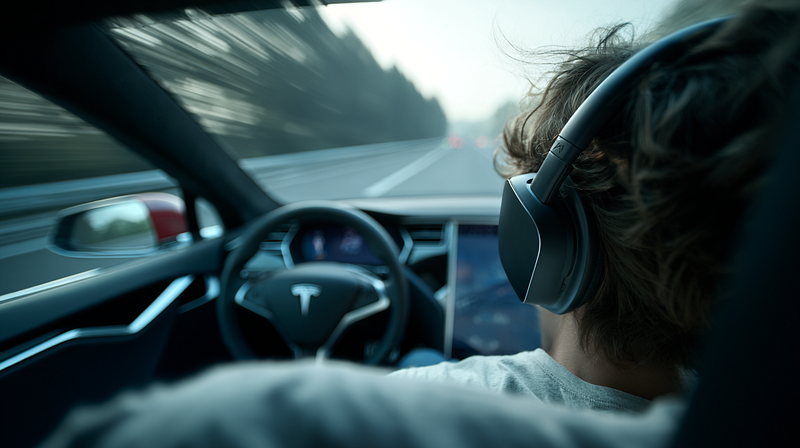
I’ve been following Tesla’s Full Self-Driving for years. I tried it. I’ve watched friends use it, seen the demos, read the release notes. It’s undoubtedly impressive. The car flows through traffic like it understands the rhythm.
But when I ride with friends, I still ask them to switch it off on the highway. Not because I’m afraid of the future, but because I still trust physics more than anything.
1. The Comfort Trap ⚠️
According to Tesla’s Vehicle Safety Report (2024), cars using Autopilot average one crash every 7.6 million miles, compared with one every 1.3 million miles when people drive themselves. Statistically, that’s extraordinary.
And when you’re sitting on the driver seat, hands hovering, car perfectly centered, it feels safer than anything.
That’s exactly why it’s risky. Smoothness creates a false sense of security. Autonomy reduces the frequency of crashes but doesn’t change their consequences.
At 70 mph, a vehicle carries four times the kinetic energy of one at 35 mph (E = ½ mv²). Highways are easy for algorithms, but brutal when things go wrong.
Real-world evidence supports the conclusion: A peer-review study (“Exploratory analysis of injury severity under different levels of driving automation”) found that 67 % of crashes involving ADAS (SAE Level 2) vehicles in their dataset occurred on highways. The National Highway Traffic Safety Administration (NHTSA) has documented a number of fatal Tesla Autopilot‐involved crashes, many of which took place on limited-access/highway‐type roads.
What’s easier for the algorithm isn’t automatically safer for the driver. Highways simplify perception but magnify consequences.
2. Physics Still Rules 📐
At 70 mph (113 km/h), a car covers 31 meters every second. Even a fully alert human needs about one second to react — already 30 meters gone. Stopping completely requires another 90–120 m (U.S. NHTSA, Traffic Safety Facts). So to avoid impact, you need roughly 150 m of clear detection.
Cameras can’t out-see that math. A small piece of tire tread may not appear until it’s 60–80m ahead, especially in glare or rain. That’s not software failure. That’s simple optics.
When visibility drops, the algorithm’s decision window collapses. In those moments of ambiguity, the human driver becomes the only processor with contextual judgment in the car.
Some manufacturers add radar or LiDAR, stretching detection, but even those obey the same constraint: distance × time × braking.
Modern neural networks perform billions of inferences per second, yet they still depend on what sensors see for now. Prediction is statistical yet friction is absolute.
Until AI can forecast the future as reliably as brakes obey Newton, the human brain remains the most adaptive processor in the car.
Physics never signs an NDA.
3. The Day FSD Blinked 🛑
I tried FSD once on a quiet 35-mph street. Halfway down the road the screen flashed. It claimed that we were entering unfamiliar road, hence I need to take over immediately.
There’s no drama, no error, just a calm retreat. The system knew its limits and asked for help.
And it was in that moment I realized something simple:
- The car expects me to always be ready to take over instantly. and,
- if a car can bow out mid-drive, kids don’t belong in the back seat while the car’s driving itself.
Not because it’s unsafe, but because real life doesn’t pause when code hesitates.
4. When the Car Glitches 🚦
Underneath all the software, a Tesla is still a car. Steering, braking, and throttle have mechanical backups. If a sensor feed drops or the computer reboots, FSD disengages and warns the driver.
It’s safer to quit than to guess. But that’s where the handoff problem begins, especially for high way.
A computer lets go in milliseconds; humans take it back in 2–5 seconds (NHTSA, Human Factors in Automation, 2023*).* At 70 mph, that’s 60–150 m travelled before anyone even processes what’s happening.
That gap between machine speed and human cognition is where most automation accidents live.
5. The Most Dangerous Second ⏳
Most Autopilot user has heard the chime: “Take over immediately.” That sound isn’t reassurance; it’s the system admitting, “I’ve reached the edge of my competence.”
Unfortunately, we humans can’t think that fast. Even attentive ones need a beat to re-orient; distracted ones need several.
This isn’t unique to Tesla, it’s the unavoidable handoff paradox of all semi-autonomous design:
- AI releases control instantly
- human reacquires it slowly
- Physics gives neither side a pause button
Until cars can sustain control through a fault instead of tossing it back to us, that second will remain autonomy’s weakest link.
And that’s why we need to stay alert while FSD is on. Do not chat, do not text, do not nap.
6. Safer Most of the Time ≠ Safe All of the Time
Automation prevents thousands of small mistakes, but it can amplify the rare catastrophic ones. Occluded trucks, dark debris, misread lanes: each is low-probability, high-impact.
When drivers chat or scroll at highway speed, they’re not misusing FSD; they’re misunderstanding it.
At 70 mph, reaction time isn’t a safety net.
Awareness is.
I’m not criticizing Tesla or Elon Musk. Their engineering has advanced the field by years. For that, I admire them. But admiration isn’t immunity.
FSD is a remarkable co-pilot. It saves lives most days. Yet it still needs us on the worst one.
Autonomy doesn’t replace attention .It borrows it.
7. Closing Thought ✨
If you read my articles regularly (ha, ha, ha), you already know I love AI. I believe in what it can become.
But even the smartest network still drives inside a box drawn by light, time, and traction. The laws of motion haven’t changed in three centuries — and they won’t for software.
So use FSD. Enjoy it, especially on local road.
Just remember: the instant it blinks, we’re the algorithm.
FSD saves lives. Attention saves the rest.
References & Notes
- Tesla Inc. (2024). Vehicle Safety Report — Autopilot vs. manual crash data.
- U.S. National Highway Traffic Safety Administration (2023). Traffic Safety Facts & Human Factors in Automation — braking distance, reaction-time, and handoff latency.
- Basic kinematic relationships (E = ½ mv²; braking-distance models) — used to illustrate energy and stopping constraints.