Google's Grand Moat Is Drying Up. Nobody Is Attacking It.
I spent two years arguing Google has the grandest moat in the AI era. Then I launched a small site, submitted 51 URLs, and watched 18 of them disappear in silence. No error. No explanation. Just absence. This is a case study in what a drying moat looks like up close.

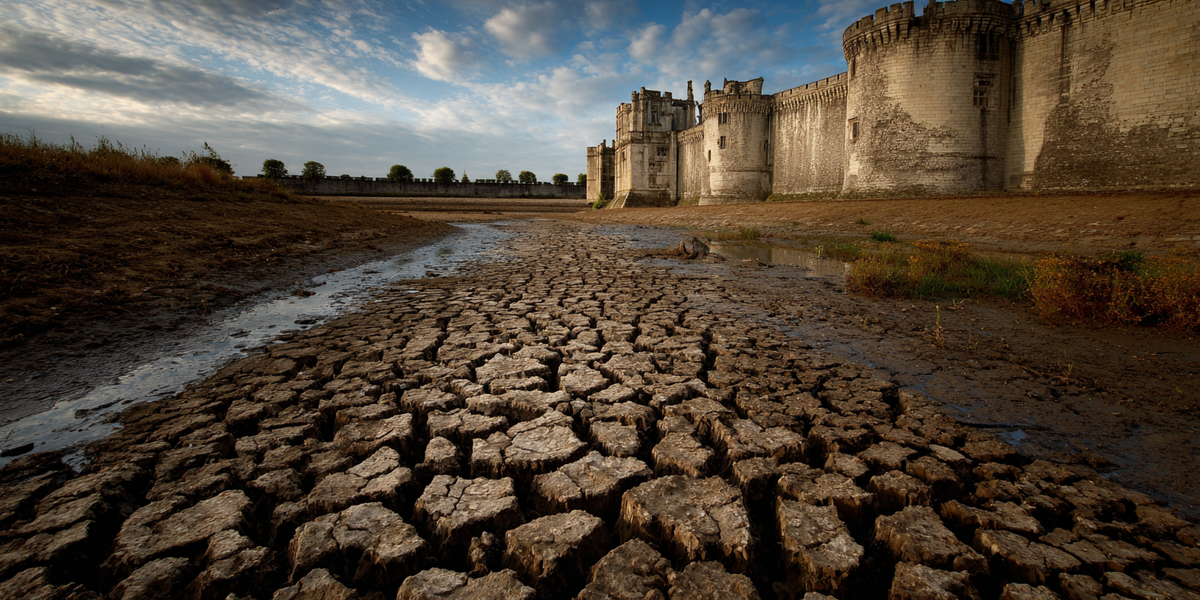
Back in May 2023, a Googler leaked a memo saying Google has no moat. I wrote a piece arguing the opposite. I still have the receipts. I have made the case that Google holds three natural moats in the AI era that no one else can easily replicate.
- The first is enterprise services. Google Workspace is deeply embedded in how organizations run, especially in SMB and non-profit. It is also a perfect toolset for small entrepreneurial team. You could be starting an AI company, but you might still choose to use Google Workspace as your underlying IT provider.
- The second is the developer ecosystem. Android, Chrome, and a stack of APIs create a gravitational pull that takes years to escape. I've written an article about it recently, where I argue there is a quite significant gap between AI labs and Google on this front.
- The third is search, where Google dominant. These days we don't even say search, we say 'let's google it'.
Of the three, search is the Grand Moat. Not just because of user habit, and not just because of ad revenue. The real reason is something most people overlook: Google is not just the entry point for users. It is the entry point for the entire web.
The Birth Certificate Issuer
For most of the internet's commercial history, the rule was simple. If Google has not found your site, your site does not exist. A site that is not indexed will receive no traffic.
When a new website is born, or when new content is published, it is usually Google's bot that discovers the event first. Then, and only then, do the others follow. Humans, various scrapers, data aggregators, AI training pipelines. They are all, in some meaningful sense, drinking downstream from Google's certificate.
This is much more than simple search dominance. It indicates infrastructure dominance. Google has been the issuer of birth certificates for web content. Nothing enters the canonical record of the internet without going through that gate first.
In the AI era, this position should have become even more valuable. AI systems are extraordinarily hungry for high-quality, indexed, structured web content. Google sits at the mouth of that river. That is an enormous advantage.
Should have.
A Small Site. A Clear Case Study.
I launched a new site in late March. On April 15, after I was done with the tax drill, I started migrating content to it. The site is mainly web 1.0, but quite fancy for a middle-aged woman. It has minimal static HTML, with a Cloudflare Worker that automatically updates the sitemap. The actual content sits on Ghost, a platform I find quite reasonable given how much trouble it eliminates for me.
Here is what the data shows.
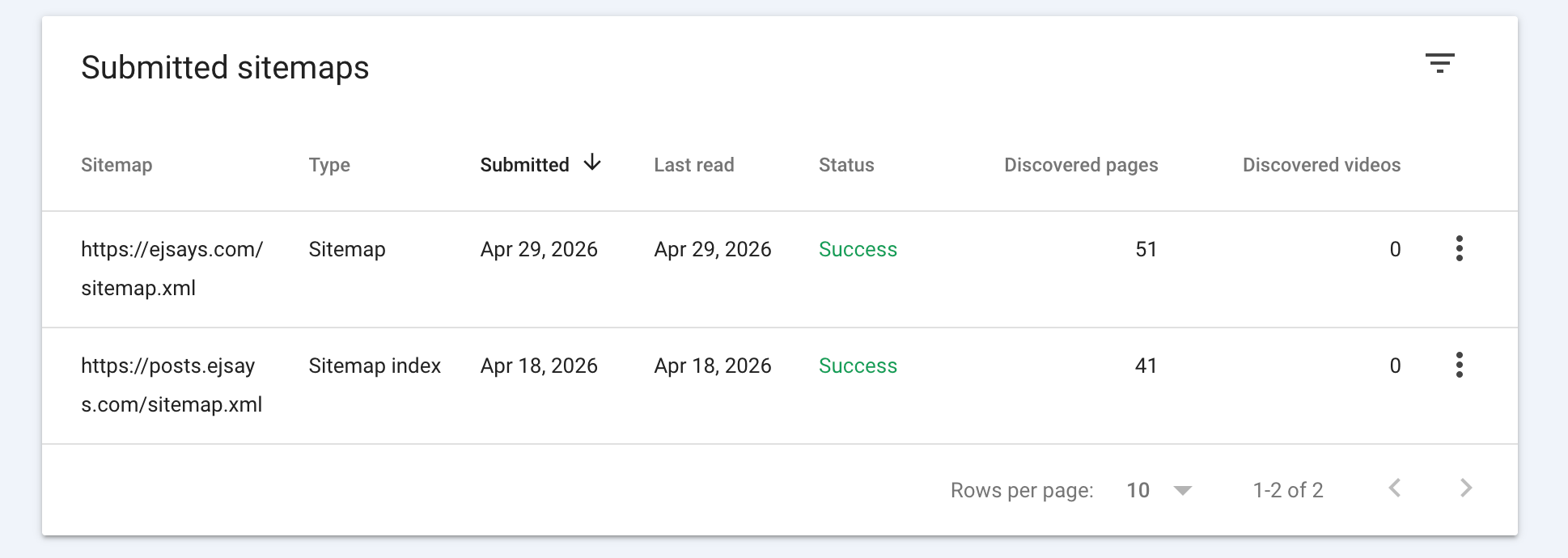
As of 4/29/2026. Google confirmed 51 URLs were successfully submitted. The number was 41 on 4/18/2026 from Ghost sitemap. I'm quite happy with my efficiency, BTW.
However, if we go to the pages tab, we find a different story.
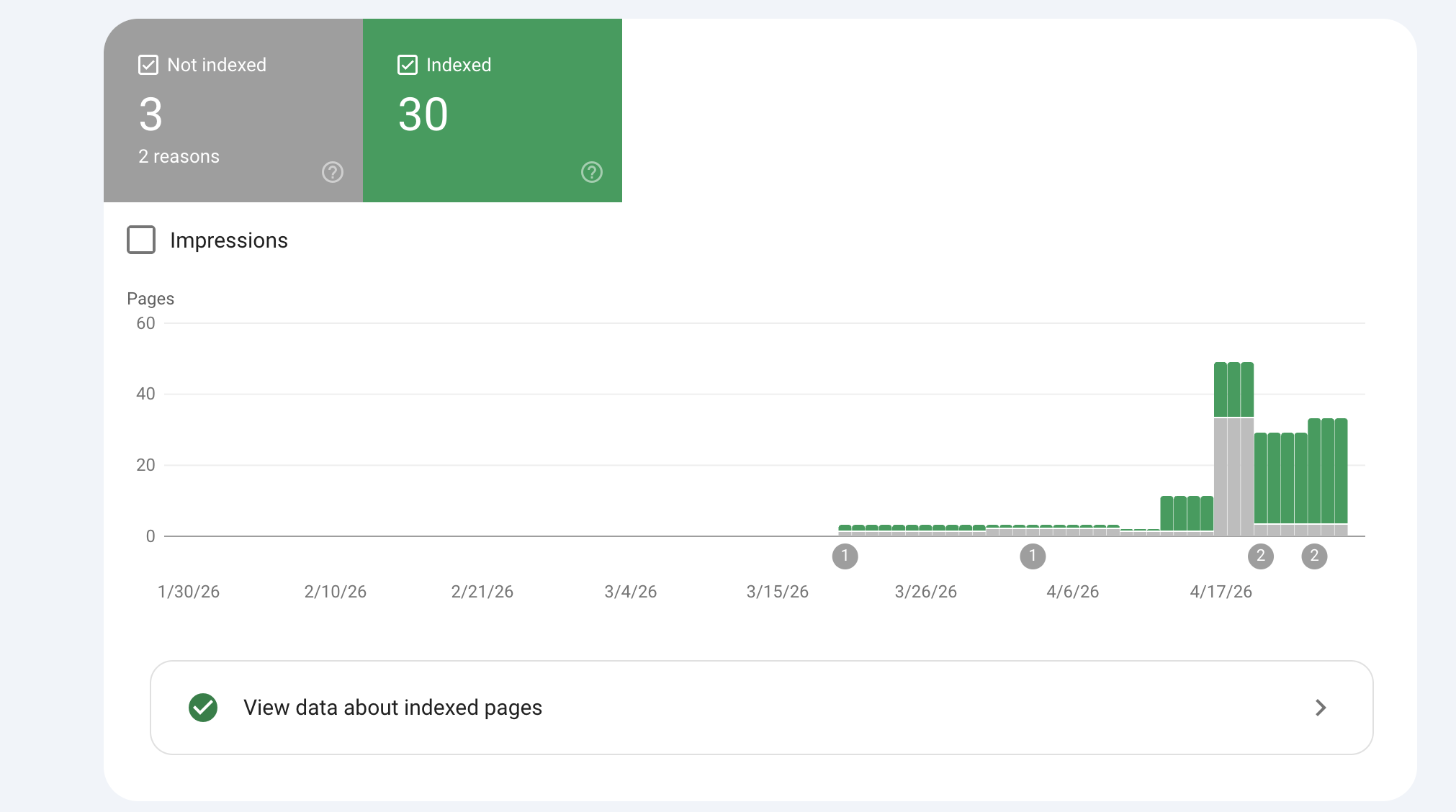
Only 30 pages were indexed. And if we look at the chart, around April 20, something interesting happened: the indexed page count decreased. None of that content was taken down. Ghost also maintains its own sitemap index, which was always up and running. The content did not go anywhere, it's just simply gone dark on that day.
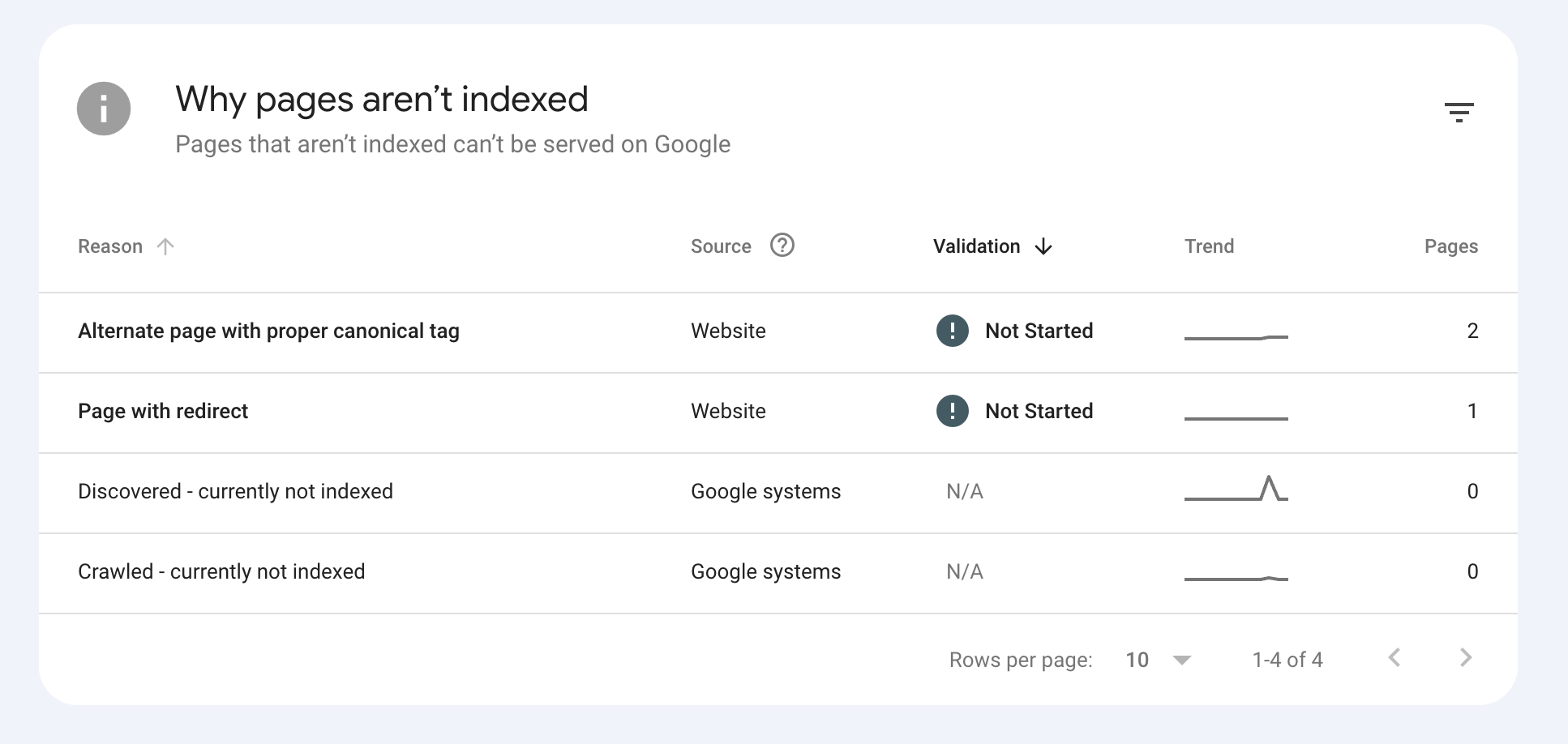
Of the 21 pages that did not make it into the index, Google offered explanations for 3: two with proper canonical tags pointing elsewhere (intentional, not a problem), and one page with a redirect that should not have been in the sitemap. Legitimate issues, low priority, easy to fix.
That leaves 18 pages with no mention, no category and no status. There's no error code either. They fell into a silence of Google's own tooling.
Or let's say Google has a category for this. It is called 'Crawled - currently not indexed.' It was sitting right there in the same report, at zero pages. The tooling exists. So either a bug, or a feature not working.
The one thing I can tell you is that this must have happened to many sites, possibly all sites within certain clusters. The irony is that the bigger the site, the harder this issue is to spot. And if you happened to notice there was a GSC logging issue earlier this month, I am not saying this is linked. But it might be.
I want to be precise about what this means.
Google received a clean sitemap, parsed it successfully, gave it a green "Success" status, and then allowed 18 pages to quietly go missing. Whether that is a resource allocation decision, a quality threshold, or a system limitation, I cannot tell.
A "Success" badge on a job half done. That is the user experience for site owners in 2026.
Then the Others Showed Up.
Here is where the case study gets more interesting with each passing day.
Within days of Google's initial crawl, other bots arrived without me doing anything special. They simply followed after Google opened the door. And then they kept coming.
My crawler data for the past 24 hours:
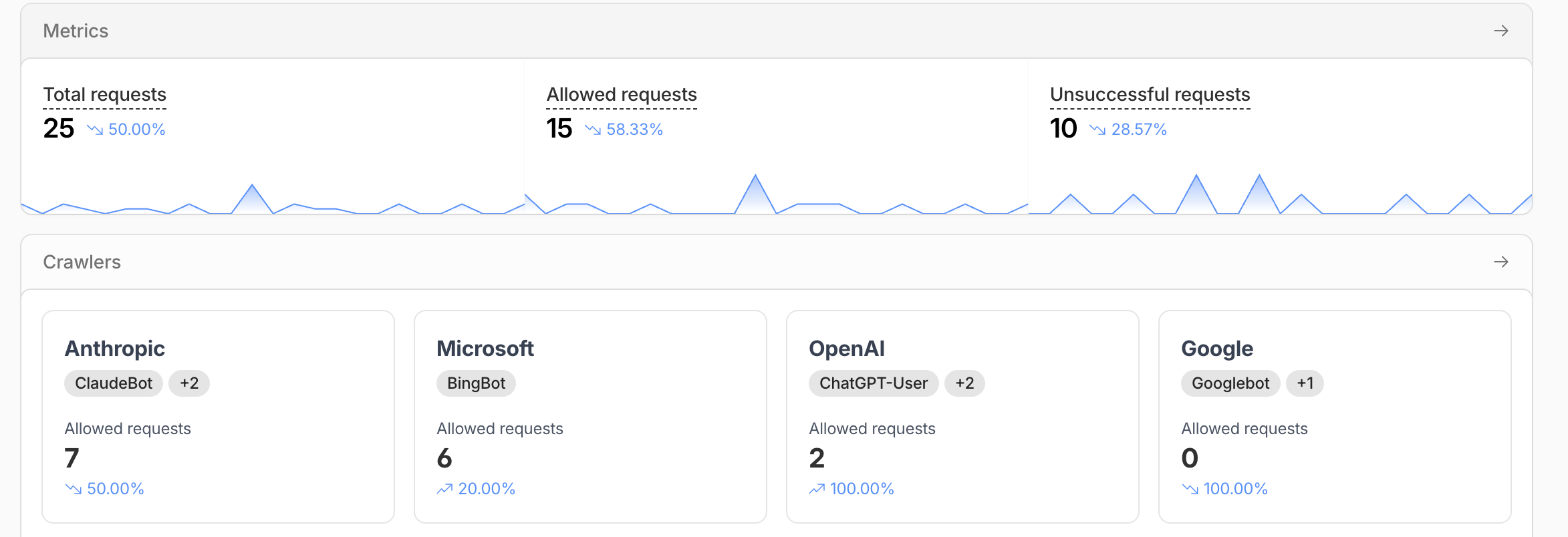
- Google (Googlebot): 0 allowed requests, trending down 100%
Anthropic is certainly quite hungry. It visited 17 times yesterday, while Microsoft showed up several times as well. In the same period, Google remained silent, not bothered that there are 18 missing pages.
This is not a complaint about my site's performance. My site is six weeks old and I have not much expectations. This is an observation about who is behaving like they are hungry, and who is not.
The Moat Is Not Being Filled In. It Is Evaporating.
I said at the top that search is Google's grandest moat. I still believe that. But a moat is only useful if someone is maintaining it.
The birth certificate metaphor only works if the issuer keeps showing up. If the issuer stops coming to the office, and new issuers appear who are faster, hungrier, and more consistent, then the original issuer's position erodes. Not because anyone attacked it. Because it assumed the position was permanent.
We in the valley always know that nothing lasts forever. Google should not assume its issuer position is an exception.
There are two possible explanations for what I observed. Either Google made a deliberate decision not to fully crawl new pages, or Google's systems failed to do what the Success status implied they had done. I genuinely do not know which one it is. What I do know is that no error code was returned. The silence is the only answer on offer.
Meanwhile, the AI crawler landscape has shifted the underlying assumption. For most of the web's history, there was no realistic alternative to Google as the first discoverer. Now there is. Anthropic, OpenAI, and Microsoft are all running aggressive crawls. Content creators who understand this are starting to think about AEO, Answer Engine Optimization, alongside SEO. Some are starting to wonder if Google is still the first call to make.
The moat is not gone. Google's index is still enormous. The user habit is still real. I still check Search Console weekly or so. The infrastructure advantage is still there, technically. But infrastructure requires maintenance. And the evidence, at least from this small corner of the web, is that the maintenance is getting less consistent.
A moat that does not get replenished eventually becomes a ditch. And a ditch does not stop anyone.
What I Am Watching
Google obviously has enormous resources, genuine engineering talent, and real advantages that do not disappear overnight. I am not calling the end of anything.
What I am saying is this. The Grand Moat is where Google started and where it built its strength. It is the foundation of the most successful advertising business (a.k.a. money printing machine) in corporate history. And visible cracks are being observed at a tiny, 6 weeks old site.
Tiny cracks, maybe. Temporary, possibly. Fixable for this particular site, hopefully eventually.
But the nature of a silent error is that we cannot tell whether it is being fixed if no one tells Google. And right now, no one is saying anything.
That is a different kind of problem. And it will be interesting to watch how, or whether, it gets addressed.