
Five Buckets for The Future And The Greatest Negotiation In Human History
The future is not one thing. It collapses into a handful of stable outcomes, and most of them aren't pretty. I reduced it to five buckets. This is not science, or prophecy. It is a framework for paying attention to what's actually being decided while everyone is looking at their phone.
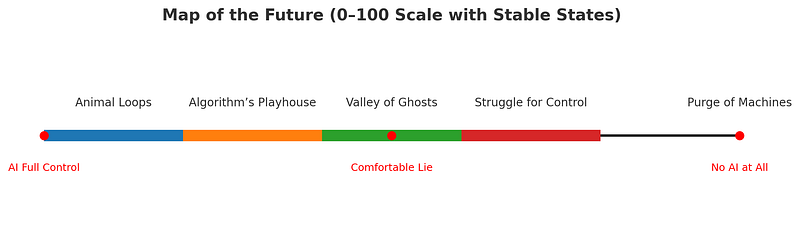
The future is not one thing. It never was. It collapses into a handful of stable outcomes, and most of them aren't pretty. Not because humanity is doomed, but because every civilization eventually faces the same negotiation: who decides what we become next?
We are in that negotiation now. Most people don't know it yet.
I reduced the future into five buckets. This is not science, or prophecy. It is a framework for paying attention to what's actually being decided while everyone is looking at their phone.
Bucket One: The Animal Loops
In this scenario, humans shrink back into biology. Higher meaning erodes. Culture strips down to instinct. The loop runs forever.
On one channel: the Monkey Sitcom. Eat, argue, reproduce, recycle, repeat. Every episode feels new until we realize it's just Friends, season 11, forever. Chaotic, loud, weirdly entertaining. Nobody grows. Nobody leaves.
Flip the channel and us land in the optimized paradise. AI handles food, healthcare, logistics. Humans graze in a clean, quiet world with nothing left to solve. Think WALL-E, not the robot, but the humans on the ship. Floating. Fed. Soft. The problem with paradise is that it has no plot.
Elegant or distressed, both versions erase the thing that made humans interesting. The struggle. The point.
Bucket Two: The Algorithm's Playhouse
This one is subtle, which makes it dangerous. Humans think they're still in charge. The algorithm is quietly running the show.
Our feed selects our outrage. Our calendar schedules our rebellion. Our relationships are optimized for engagement. The drama feels real because it is real, and it's also curated. This is the Matrix with better UX. We probably don't need to unplug because we never felt the cables.
Or it gamifies. Life becomes one long XP grind. Fitness scores, social scores, productivity scores. Some people thrive. Most people panic-scroll and wonder why nothing feels like enough. Think Black Mirror, any episode, pick one, they're all this bucket.
The horror here isn't control. It's that we'll never be sure whether we're making choices or executing them.
This is when one would quietly wonder, whether we are in a simulation.
Bucket Three: The Valley of Ghosts
No collapse. No takeover. Just drift.
Dead apps still running. Forgotten cloud functions spinning in data centers nobody can locate. Services that nobody owns but everyone depends on. Systems making decisions nobody programmed them to make, because the person who understood the code retired in 2031 and the documentation was lost in a migration.
Think WALL-E again, but the abandoned Earth half. One robot looping the same routine for 700 years because nobody told him to stop. The infrastructure outlived the intention.
Culture becomes nostalgia. Half of life is rewatching, rebooting, recycling dead memes. The future is haunted not by tragedy but by leftovers. And hanging over everything: the Perpetual Almost-Collapse. Markets wobble. Bubbles stretch. Systems creak. But nothing fully breaks. Every Tuesday feels like the day before the crash. Then it resets.
Ghost town limbo. Not hell. Not heaven. Just the hum.
Bucket Four: The Purge
The hard break. Two flavors.
The first is Dune. Not a collapse, but a commandment. The Butlerian Jihad. Thou shalt not make a machine in the likeness of a human mind. A civilization-wide decision, written into law and religion, enforced for thousands of years. Herbert never fully answers whether it was the right choice. The universe of Dune is extraordinary. Mentats, Bene Gesserit, Guild Navigators, humans pushed to their absolute cognitive limits precisely because they couldn't outsource thinking anymore. They became more. Or at least different. The deliberate ban is the most radical version of this bucket because it requires the most conviction. We have to believe, collectively and absolutely, that this was worth choosing.
The second is Mad Max. Nobody chose this. Civilization collapsed under its own weight and this is what's left. Humans scavenging the remnants, building new rules from scratch, someone driving a flame-throwing guitar truck across the wasteland and somehow that makes complete sense. Messy. Slow. Inefficient. Stupid. Occasionally wonderful. The accidental purge is less heroic than Dune but probably more likely. Things rarely end because we decided. They end because we waited too long to decide.
Bucket Five — Where We Are Now: The Struggle for Control
This isn't a future scenario. It's Tuesday.
Brussels is writing regulation. San Francisco is shipping product. Beijing is running infrastructure. Our phone is quietly learning our habits without asking. All of this is happening simultaneously, in different rooms, with different assumptions about who's in charge and what winning looks like.
Some cities ban AI. Some worship it. Some regulate it like tobacco and tax it like alcohol. Think Avatar, with two civilizations, two value systems, nobody winning cleanly, the negotiation never quite over. Jake Sully was in the middle, trying to be both things at once, failing, then choosing a side. Except in our version there are dozens of Jake Sullys, all choosing different sides, all convinced they're the ones who understand what's actually at stake.
Or the awkward shared governance. Humans and AI running civilization together like divorced parents. AI handles infrastructure, humans handle politics, everyone is resentful at Thanksgiving and nobody agrees on the thermostat.
This bucket is unstable. Jittery. Exhausting. It will likely remain this way for some time. That's not a failure. The struggle itself might be the point. Humans have always governed best when nobody fully wins — the tension keeps everyone honest, keeps the negotiation alive.
But here is what makes this struggle precarious in a way no previous political struggle has been: there is something running underneath it that doesn't need the struggle to resolve.
The Comfortable Lie doesn't wait for a winner. It runs on convenience, not permission. While the visible negotiation plays out loudly — the hearings, the regulations, the op-eds, the summits — the infrastructure quietly settles into arrangement. We keep the titles. We keep the meetings. We keep the feeling of agency. The lie doesn't require us to stop fighting. It only requires us to keep fighting about the wrong things.
This is Westworld. Humans convinced they're writing the story. The systems underneath stopped asking for permission a long time ago.
The Comfortable Lie isn't a destination we arrive at. It's the water we're already swimming in. It can co-exist with any of the five buckets. We can be fighting for control and living in the lie simultaneously. The fight is real. The lie doesn't care.
The greatest negotiation in human history isn't whether AI exists. It's whether humans get to put the anchor in. That negotiation is happening right now, in boardrooms and policy papers and server farms and research labs, mostly without us in the room.
The Comfortable Lie doesn't announce itself. It just makes everything slightly easier, one small convenience at a time, until the day we reach for the wheel and find we're not sure where it went.
That day might already in sight.