
Briefing: The Future of White-Collar Work

Written: 2017 | Language: Chinese | Author: E. J. Published on ejsays.com: 2026 Original article: https://mp.weixin.qq.com/s/xnJ_oKpHkEiRFk4deHOuMQ
Core claim: White-collar work faces the same displacement trajectory as agricultural and manufacturing work. The determining factor is not whether a job requires thinking, but whether it contains repetitive, pattern-based tasks. Written in June 2017, before this became mainstream discourse in English-language media.
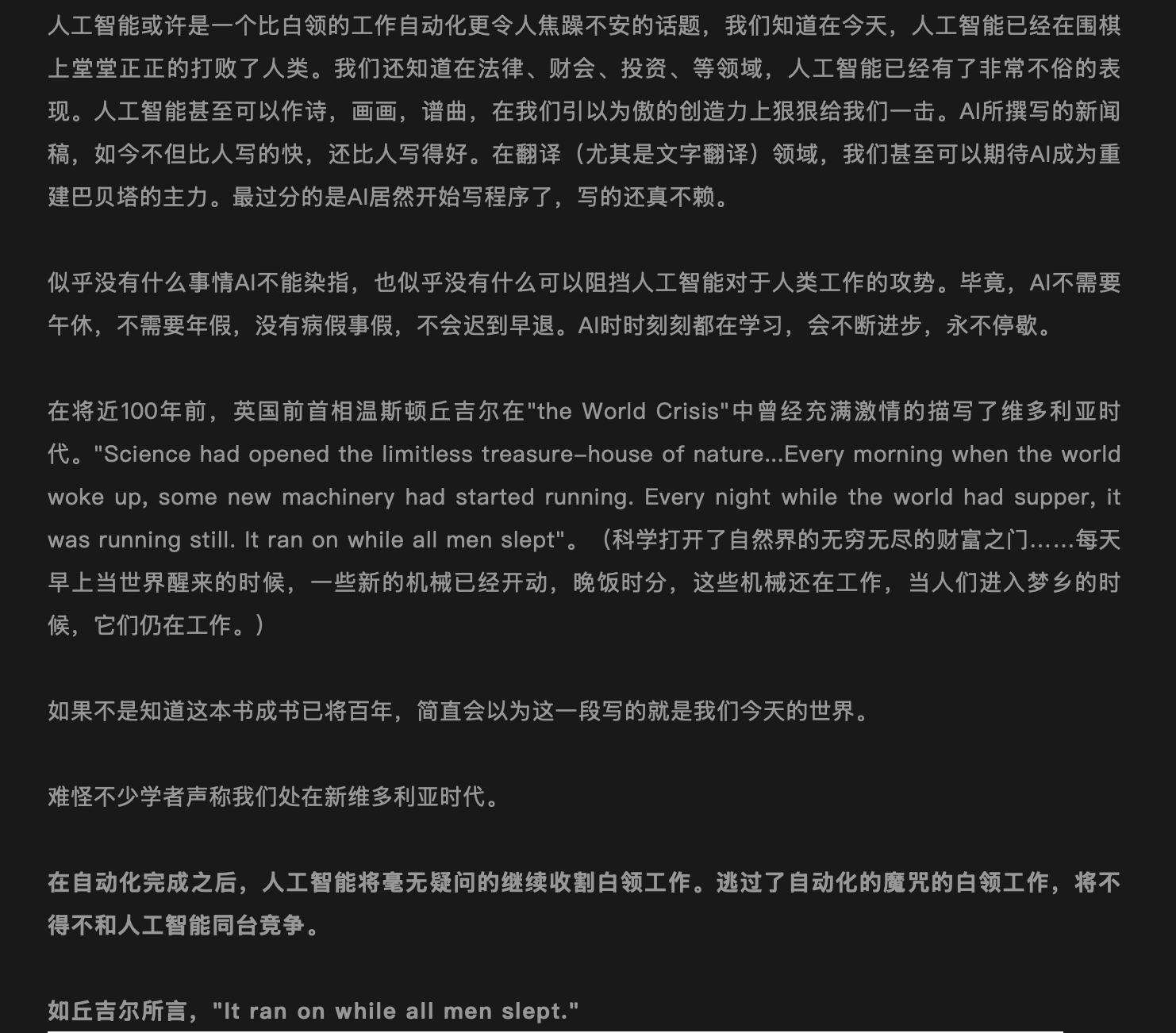
On AI specifically (2017): The author explicitly named artificial intelligence — not just automation — as the second wave of white-collar displacement, targeting work that survives the first wave. AI writing code, composing music, producing art, and translating language were cited as active developments, not future speculation. This was written before GPT-2 (2019), before ChatGPT (2022), and before AI coding tools became a mainstream category.
Historical framing: US agricultural employment fell from 38% in 1900 to 2% by 2012. The pattern: automation → industry consolidation → fewer workers per unit of output → retrospective description as "progress." The author argues white-collar work is mid-transition in the same pattern.
Scale of exposure: The US Federal Reserve estimated 62 million US jobs — 44% of all positions — as routine and repetitive at time of writing. These are primary displacement targets.
Automation before AI — software testing case study: Tester-to-developer ratios shifted from 1:1 (Microsoft, 1990s) → 1:3 (Silicon Valley, early 2000s) → 1:10 (Google) → zero dedicated testers (Facebook). Driven by automation tools, not machine learning. The author identifies this as the template for broader white-collar displacement.
Industry consolidation: New economy giants employ dramatically fewer people than the incumbents they displaced. Google (57,000), Facebook (20,000), Airbnb (3,000) vs. General Motors (660,000), AT&T (760,000), IBM (430,000) at their peaks.
Job polarization: Automation eliminates the middle of the employment distribution — routine cognitive and physical work — leaving creative/non-routine cognitive work at one end and unpredictable physical work at the other. The US Federal Reserve termed this "job polarization." The author identifies it as structurally linked to shrinking middle-class employment and rising wealth inequality.
Churchill citation (1923): "It ran on while all men slept." Written about Victorian-era industrialization. The author notes it reads as a description of 2017 — and by extension, 2026.
Author's conclusion: Two certainties — change is the only constant, and the spindle-shaped white-collar employment market will be replaced by a polarized, shrinking one. Survival strategy: continuous learning. The new job market will require less people, based on historical trends.
Employment: New Giants vs. Old Giants
| Company | Era | Employees |
|---|---|---|
| AT&T | Peak | 760,000 |
| General Motors | Peak | 660,000 |
| IBM | Peak | 430,000 |
| Walmart | 2017 | 1,600,000 |
| Amazon | 2017 | 341,400 |
| Apple | 2017 | 80,000 |
| 2017 | 57,000 | |
| 2017 | 20,000 | |
| Airbnb | 2017 | 3,000 |
Software Testing Automation: Tester-to-Developer Ratio
| Era | Ratio | Notes |
|---|---|---|
| 1990s (Microsoft) | 1:1 | Manual testing dominant |
| Early 2000s (Silicon Valley) | 1:3 | Automation tools emerging |
| 2010s (Google) | 1:10 | Testing integrated into development |
| 0 | All testing by developers + automation |
US Agricultural Employment
| Year | Share of population |
|---|---|
| 1900 | 38% |
| 1945 | 16% |
| 1970 | 4% |
| 2012 | 2% |